The Growing Conflict Between Delivery Robots and Cyclists
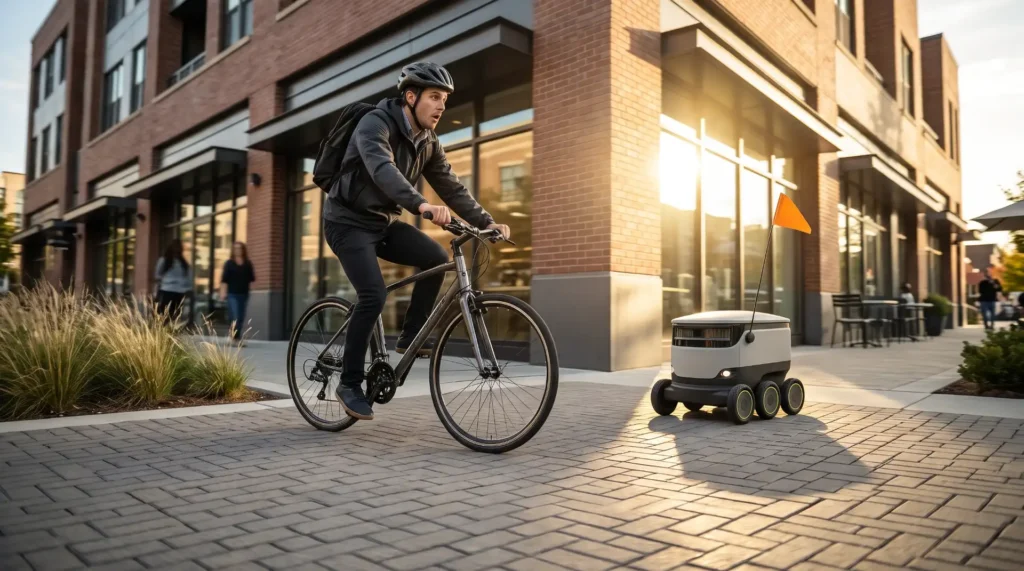
Technology is changing how Americans receive groceries, restaurant meals, household supplies, and other everyday purchases. In addition to traditional delivery vehicles, some businesses are beginning to use small autonomous delivery robots that travel along sidewalks, crosswalks, and other designated pedestrian areas. These compact machines are designed to transport packages without requiring a human driver to accompany them throughout the delivery route.
Although autonomous delivery robots offer potential advantages, including reduced reliance on delivery vehicles for short trips, their growing presence creates new safety questions for pedestrians and cyclists. A robot that unexpectedly stops in a bicycle lane, blocks a sidewalk, turns across a cyclist’s path, or fails to recognize an approaching bicycle could contribute to a collision resulting in serious injuries.
Unlike a conventional vehicle accident, a collision involving an autonomous delivery robot may involve several parties. The company operating the robot, the manufacturer, the software developer, a remote monitoring employee, and potentially a business using the delivery service could become relevant to an investigation.
For an injured cyclist, identifying who pays for medical expenses, lost income, bicycle damage, and other losses may be complicated. The robot does not have a conventional driver who can automatically be identified as the responsible motorist. Instead, investigators may need to examine its programming, sensors, maintenance history, operating instructions, remote-control systems, and the conduct of the company responsible for deploying it.
These issues are becoming increasingly relevant as communities consider how autonomous delivery technology should share public spaces with traditional transportation users.
The central legal question is not simply whether a robot caused a collision. It is whether a person or organization failed to exercise reasonable care, violated an applicable safety requirement, supplied a defective product, or otherwise contributed to the injuries.
Understanding these possibilities can help cyclists recognize their rights and know what evidence may matter after an accident.
What Are Autonomous Delivery Robots?
Autonomous delivery robots, sometimes called personal delivery devices or sidewalk delivery robots, are small, ground-based machines designed to transport goods from one location to another.
They are commonly used or tested for short-distance deliveries involving restaurants, grocery stores, convenience stores, and other businesses.
Unlike traditional delivery trucks, these machines generally travel at relatively low speeds and may use sidewalks, crosswalks, and other pedestrian-accessible areas. Their exact permitted operating locations depend on state legislation, local rules, and the conditions under which the operator has been authorized to deploy them.
How Delivery Robots Navigate Public Spaces
Most modern delivery robots use combinations of cameras, sensors, mapping technology, GPS, and automated navigation software.
These systems help the machine identify obstacles, estimate distances, recognize pathways, and respond to changes in its surroundings.
For example, a robot approaching a pedestrian crossing may use its sensors to detect people walking across its intended route. It may slow down, stop, or attempt to navigate around the obstruction.
However, these systems are not perfect.
A delivery robot may have difficulty recognizing certain objects, responding to unexpected movements, or navigating an area with unusual lighting and complicated traffic patterns. A bicycle approaching from behind, a cyclist emerging from a driveway, or a rider traveling through a crowded intersection may create a situation that the robot’s software does not handle correctly.
Some delivery systems also rely on remote human monitoring. An employee may supervise multiple robots from another location and intervene when a machine encounters a problem.
This arrangement raises additional questions about how quickly a remote operator can recognize an approaching hazard and whether the company provides sufficient monitoring and emergency response procedures.
Why Cyclists Face Particular Risks
Cyclists occupy a different position in transportation networks than pedestrians and motor vehicles. They may travel faster than people walking but often share portions of the public right-of-way with pedestrians.
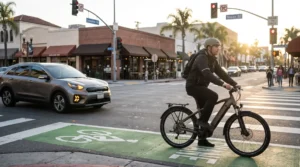
A delivery robot that blocks a sidewalk may force a cyclist to move into a roadway. A machine that enters a bicycle lane may create a sudden obstruction that leaves the rider with little time to react.
The risk becomes greater when the cyclist is traveling downhill, approaching an intersection, riding in poor weather, or navigating a narrow passage.
Even a relatively small robot can create a dangerous obstacle. A cyclist who strikes its rigid exterior may be thrown over the handlebars, lose control, or collide with another road user.
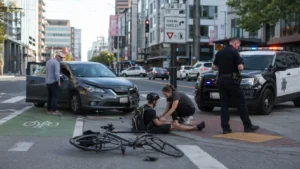
Injuries can include fractures, shoulder damage, head trauma, facial injuries, spinal injuries, and road rash. The severity depends on the cyclist’s speed, the direction of impact, the surrounding environment, and whether another collision occurs afterward.
How Autonomous Delivery Robot Accidents Can Happen
Delivery robot collisions can occur in several ways. Understanding the specific circumstances is important because different accident scenarios may point toward different forms of legal responsibility.
Delivery Robots Blocking Bicycle Lanes
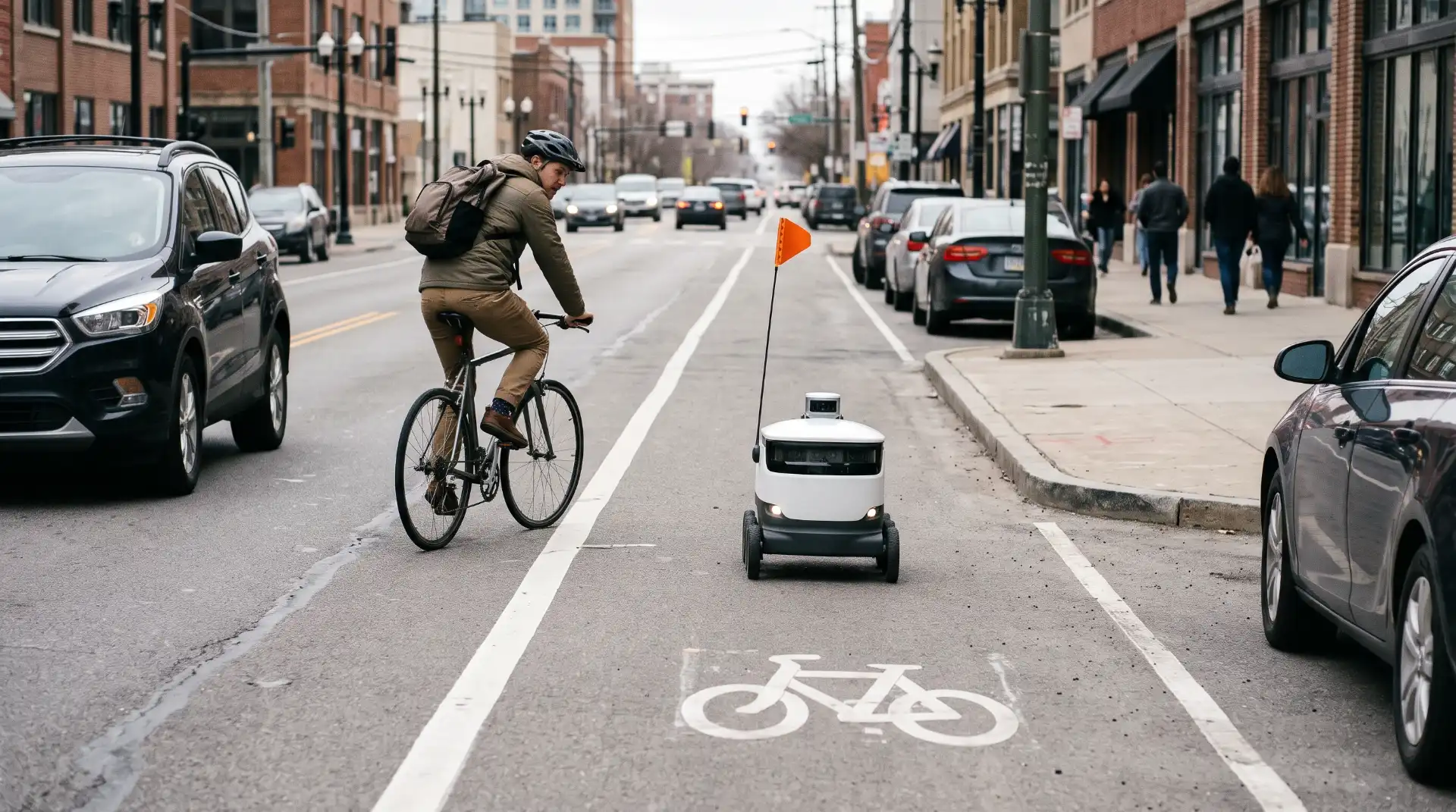
One potential hazard occurs when an autonomous delivery robot enters or stops inside a designated bicycle lane.
A robot might move into a bicycle lane to avoid a pedestrian, navigate around construction equipment, or reach a nearby delivery destination. It might also stop because its sensors detect an object that the software cannot identify.
For a cyclist approaching from behind, an unexpected obstruction can create an emergency situation.
The rider may attempt to swerve into a motor vehicle lane, brake suddenly, or move toward the sidewalk. Each reaction carries additional risks.
If the robot stops without adequate warning or occupies an area where its operation is prohibited, investigators may examine the company’s route-planning system, operating permissions, and safety procedures.
Robots Suddenly Changing Direction
Autonomous machines must continuously interpret their surroundings and determine where to move.
A robot may change direction when it encounters a pedestrian, another robot, construction equipment, or a temporary obstruction.
If its navigation software does not adequately account for approaching cyclists, the machine could turn into a rider’s path.
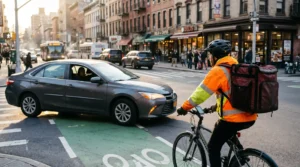
Consider a cyclist traveling through a downtown intersection. A delivery robot approaches a crosswalk and begins turning toward the opposite sidewalk. The cyclist has the right of way under the applicable traffic rules, but the robot moves directly across the bicycle’s path.
The resulting collision could raise questions about whether the machine was programmed to recognize bicycles, whether its route was appropriate, and whether the company adequately tested the system before deploying it.
Robots Stopping Without Adequate Warning
Unexpected stops can also cause bicycle accidents.
A robot may suddenly halt because of a sensor error, a software malfunction, a communication interruption, or an obstacle detection problem.
If a cyclist is following another rider or traveling through a crowded bicycle corridor, the sudden stop may leave insufficient distance for safe braking.
The first cyclist might avoid the robot but force another rider to collide with it. In some circumstances, multiple cyclists could become involved in a chain-reaction accident.
Investigators would need to determine whether the stop was a reasonable response to an immediate hazard or the result of a preventable technical or operational failure.
Robots Blocking Sidewalk Access
Sidewalk obstructions can also create indirect bicycle accidents.
A delivery robot might stop near a building entrance, curb ramp, driveway, or narrow sidewalk. A cyclist or pedestrian may have to move around it and enter an area with moving traffic.
For example, a cyclist using a permitted shared pathway may approach a robot blocking most of the available space. The rider attempts to pass, moves toward the roadway, and collides with a vehicle.
The robot may not have directly struck the cyclist, but its placement could still become relevant to the accident investigation.
Whether the robot operator or another party can be held responsible would depend on the applicable law, the foreseeability of the resulting danger, and whether the obstruction actually contributed to the collision.
Sensor and Navigation Failures
Autonomous delivery robots depend on sensors and software to understand their environment.
A camera may fail to recognize a cyclist under certain lighting conditions. A sensor may become obstructed by dirt or damage. A navigation system may rely on outdated mapping information.
A machine could also incorrectly identify a safe route and move into a prohibited or dangerous area.
When a technical failure contributes to a collision, the investigation may extend beyond the delivery company to include manufacturers, component suppliers, and software developers.
Who Is Liable When an Autonomous Delivery Robot Hits a Cyclist?
There is no single nationwide rule that automatically determines who pays after every autonomous delivery robot accident.
Liability depends on the facts, the applicable state law, local operating requirements, and the relationship between the companies and individuals involved.
Several parties may need to be investigated.
1. The Autonomous Delivery Robot Operating Company
The company operating the delivery robot may be one of the first parties considered after a collision.
An operating company may control the robot’s deployment, routes, maintenance, software updates, monitoring procedures, and operating hours.
If the company fails to take reasonable precautions, it may potentially face a negligence claim.
Examples of conduct that could become relevant include:
-
Deploying robots in locations where they are not authorized to operate.
-
Failing to maintain functioning braking systems.
-
Ignoring repeated reports of dangerous navigation behavior.
-
Using outdated software that creates foreseeable safety problems.
-
Failing to provide adequate remote monitoring.
-
Allowing robots to operate in unsafe weather or visibility conditions.
-
Failing to establish reasonable emergency response procedures.
For example, imagine a delivery company receives several complaints that its robots repeatedly stop inside a busy bicycle lane. The company does not investigate or correct the problem. A cyclist later crashes into one of the machines at the same location.
The earlier complaints could become important evidence when evaluating whether the company knew or should have known about the hazard.
However, the existence of a complaint does not automatically establish liability. The injured cyclist would still need to demonstrate the required legal elements, including duty, breach, causation, and damages under the applicable law.
2. The Robot Manufacturer
The manufacturer may face responsibility if a defective design or manufacturing problem contributes to the collision.
Product liability law generally provides several possible theories for holding manufacturers responsible for dangerous products.
Design defects involve problems with the product’s design that make it unreasonably dangerous under the applicable legal standard.
For example, a delivery robot may have a design that makes it difficult for cyclists to recognize its position at night. If the machine lacks appropriate visibility features or has an unsafe braking configuration, the design could become an issue in a product-liability investigation.
Manufacturing defects occur when a particular machine differs from its intended design because something went wrong during production or assembly.
A robot might leave the factory with a defective braking component, improperly installed sensor, or faulty electrical connection.
Failure-to-warn claims involve inadequate warnings or instructions concerning foreseeable risks associated with a product.
For instance, a manufacturer may need to provide appropriate operating instructions explaining limitations involving steep surfaces, narrow pathways, weather conditions, or sensor performance.
A cyclist injured by a defective delivery robot may need technical inspection, engineering analysis, and other evidence to establish the source of the problem.
The manufacturer is not automatically responsible whenever a robot malfunctions. Normal wear, improper maintenance, unauthorized modifications, and operator negligence may also contribute to equipment problems.
3. Software Developers and Technology Providers
Software plays an important role in autonomous delivery systems.
The technology may determine how a robot identifies obstacles, selects routes, recognizes pedestrians, responds to cyclists, and stops when an unexpected situation occurs.
If a software defect contributes to a collision, the developer or another technology provider may become relevant to the investigation.
For example, a navigation update might cause robots to interpret certain bicycle lanes as permissible pedestrian routes. If the system repeatedly sends machines into these areas, the software design and testing process may deserve examination.
Another possibility involves an automated braking algorithm that fails to respond appropriately when a cyclist enters the robot’s path.
Software-related liability can be legally complicated. A claimant must establish an applicable legal theory and demonstrate how the technology provider’s conduct or product contributed to the injuries.
The developer may not be responsible simply because it created software used by a company that operates delivery robots.
The contractual relationship, product characteristics, applicable product-liability rules, and specific cause of the collision all matter.
4. Remote Human Operators and Monitoring Employees
Many delivery robots are designed to operate autonomously while remaining subject to remote human supervision.
This means a human employee may monitor the machine’s activity and intervene when necessary.
A remote operator might be able to stop the robot, change its route, or help it navigate around an obstruction.
If an employee receives an emergency notification but fails to respond appropriately, the conduct may become relevant to a negligence claim.
For example, a monitoring employee might receive repeated warnings that a robot is malfunctioning near a crowded bicycle corridor. If the employee has the ability and responsibility to stop the machine but fails to act, investigators may examine the company’s monitoring policies and the employee’s actions.
The employer may also face potential vicarious liability when an employee’s negligent conduct occurs within the scope of employment, depending on the governing law.
However, a company cannot automatically avoid responsibility by claiming that a machine was operating autonomously. Human supervision, maintenance, deployment, and safety management remain important considerations.
5. Restaurants and Businesses Using Delivery Robots
A restaurant or retail business may also become relevant after an accident, although simply using a delivery robot does not automatically make the business liable.
The business may have responsibilities related to the location where robots are loaded, dispatched, or directed to collect orders.
Suppose a restaurant repeatedly instructs delivery robots to wait outside its entrance. The machines occupy a narrow sidewalk and force cyclists and pedestrians to maneuver around them.
If the business controls the area or contributes to an unsafe obstruction, its conduct may warrant investigation.
The same applies when a business provides unsafe instructions or knowingly continues using a delivery service despite recurring hazards.
The legal outcome depends on the business’s actual role, control over the location, knowledge of the danger, and the applicable duties under state and local law.
6. Property Owners and Government Entities
Some collisions occur on sidewalks, public pathways, private shopping-center walkways, or areas undergoing construction.
A property owner or government agency may become relevant if unsafe premises conditions contribute to the accident.
For example, a robot may be directed through a narrow sidewalk because the normal pathway is blocked by construction equipment. The collision might involve questions about the robot operator’s route planning and the party responsible for maintaining the construction area.
Claims against public entities are especially complicated because government liability rules, notice requirements, immunities, and shorter filing deadlines may apply.
An injured cyclist should not assume that a city is responsible simply because the accident happened on a public sidewalk.
The investigation must identify the specific dangerous condition, the party responsible for it, and the legal basis for a claim.
State Laws Governing Autonomous Delivery Robots in the United States
One of the biggest challenges in autonomous delivery robot accident cases is that the United States does not have one uniform set of operating rules covering every sidewalk delivery robot.
Instead, states have adopted different approaches to defining personal delivery devices, establishing operating requirements, regulating human supervision, and determining where these machines can travel.
Local rules may also affect how robots operate in particular cities and neighborhoods.
These differences matter because a delivery robot that is permitted to use a sidewalk in one state may face different restrictions in another jurisdiction.
Texas: Business Responsibility and Human Monitoring
Texas has adopted specific legislation addressing personal delivery and mobile carrying devices.
Under Chapter 552A of the Texas Transportation Code, a personal delivery device is generally defined as a machine designed to transport cargo in a pedestrian area or along the side or shoulder of a highway using automated driving technology with remote human support or supervision.
The law establishes several operating requirements.
A business entity must operate the personal delivery device, and a human agent must have the capability to monitor or exercise physical control over its navigation and operation.
Importantly, Section 552A.0003 generally identifies the business entity as the operator of an engaged personal delivery device for purposes of assessing compliance with applicable traffic laws, subject to specified exceptions.
Texas also establishes speed restrictions. Personal delivery devices generally cannot travel faster than 10 miles per hour in pedestrian areas or 20 miles per hour along the side of a roadway or highway shoulder.
The legislation also addresses braking systems, identification information, nighttime lighting, and local regulatory authority.
These requirements can become important after a collision. If a robot was operating without required monitoring, exceeded an applicable speed limit, or lacked required equipment, the circumstances may support an investigation into regulatory violations and possible negligence.
However, a violation does not automatically establish every element of a personal injury claim.
Cyclists and injured pedestrians can review the official legislation through the Texas Transportation Code, Chapter 552A.
Virginia: Personal Delivery Device Insurance Requirements
Virginia is another important example of a state with legislation specifically addressing personal delivery devices.
The state’s legal framework recognizes that these machines can operate in pedestrian areas while remaining subject to applicable requirements.
Insurance is particularly important.
Arlington County’s official information about personal delivery devices explains that operators using the public right-of-way must maintain at least $100,000 in general liability insurance.
This is relevant to injured cyclists because it demonstrates that insurance requirements can be part of the regulatory framework governing delivery robot operations.
Nevertheless, the existence of an insurance requirement does not mean every accident will automatically qualify for payment. Coverage depends on the policy, the circumstances of the accident, exclusions, and the legal basis of the claim.
Arlington has also documented the introduction of delivery robot operations in its community, illustrating how local transportation systems are adapting to these machines.
More information is available through the Arlington County Personal Delivery Devices program.
Pennsylvania: Priority for Pedestrians and Cyclists
Pennsylvania has established detailed requirements for personal delivery devices under its Vehicle Code.
The Pennsylvania Department of Transportation explains that personal delivery devices must yield the right of way to pedestrians and pedalcyclists in pedestrian areas.
The state also establishes operating restrictions involving device dimensions, weight, speed, equipment, and permitted locations.
These rules are particularly relevant to cyclists because they expressly address the relationship between delivery robots and pedalcyclists.
Suppose a robot enters a pedestrian area and fails to yield to a cyclist traveling through that space. The applicable requirements may become relevant when investigators evaluate the machine’s operation and the company’s compliance.
However, the precise legal consequences depend on the facts and the provisions applicable to the particular location.
The Pennsylvania Department of Transportation’s personal delivery device requirements provide additional information.
Why State and Local Differences Matter
A cyclist injured by a delivery robot should identify where the accident occurred and determine which laws applied to the machine.
Relevant questions include whether the device was authorized to operate in that location, whether it was allowed to use the sidewalk or roadway, what speed restrictions applied, whether remote monitoring was required, and whether insurance coverage was mandatory.
The classification of a personal delivery device can also matter.
Some states treat these machines as pedestrians for particular legal purposes. That classification does not necessarily mean that the company operating the device is immune from negligence or product-liability claims.
Similarly, a robot’s legal permission to use a sidewalk does not give its operator unlimited authority to obstruct public access or disregard applicable safety requirements.
Can a Cyclist Sue an Autonomous Delivery Robot Company?
Yes, an injured cyclist may potentially pursue a personal injury claim against a delivery robot operating company or another responsible party.
The fact that the accident involved an autonomous machine rather than a conventional vehicle does not automatically eliminate the possibility of legal recovery.
However, the cyclist must establish an appropriate legal basis for the claim.
Establishing Negligence
Negligence is one of the most important legal theories in personal injury cases.
Generally, a negligence claim requires evidence of four elements:
-
Duty of care: The defendant owed a legally recognized duty to act with reasonable care.
-
Breach of duty: The defendant failed to meet the applicable standard of care.
-
Causation: The defendant’s conduct was a legally sufficient cause of the accident and injuries.
-
Damages: The cyclist suffered actual harm or financial losses.
Consider a delivery company that operates robots in a crowded downtown area.
The company receives repeated reports that its machines are entering bicycle lanes and stopping unexpectedly. Despite these warnings, it fails to investigate the problem or implement reasonable safety measures.
A cyclist later approaches a robot that suddenly stops in the bicycle lane. The cyclist cannot avoid it and suffers a fractured wrist and shoulder injury.
The cyclist may investigate whether the company failed to maintain the device, correct a known safety problem, or establish adequate operating procedures.
The earlier complaints, maintenance records, software logs, and accident footage could help establish what the company knew and whether its conduct contributed to the crash.
The claimant must still prove causation and damages. A history of complaints alone does not establish that the company caused a particular accident.
Establishing Product Liability
A separate claim may be possible when a defect in the delivery robot causes the accident.
For example, a braking system may fail because of a defective component, or a sensor may consistently fail to recognize approaching bicycles under foreseeable operating conditions.
Depending on state law, the injured cyclist may investigate claims against the manufacturer, component supplier, distributor, or another party in the product’s commercial chain.
Product-liability cases often require technical evidence.
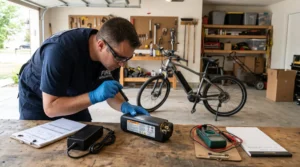
An expert may need to inspect the machine, examine the relevant component, review its engineering specifications, and determine whether the failure resulted from a defect, inadequate maintenance, misuse, or another cause.
The injured cyclist should avoid allowing potentially important components to be discarded or altered before they can be properly examined.
Can Multiple Companies Share Responsibility?
Yes. More than one party may contribute to an accident.
A manufacturer might have supplied a robot with a defective braking system, while the operating company failed to perform required maintenance.
A software developer might have provided a navigation update that introduced a dangerous behavior, while the delivery company continued operating the machines despite receiving reports of problems.
Depending on the evidence and applicable law, multiple defendants may be included in a claim.
State rules determine how responsibility is allocated among parties. Some jurisdictions use comparative fault systems, while others follow different approaches.
The fact that several companies are involved does not mean they will automatically share liability equally.
Each party’s conduct and legal responsibilities must be examined independently.
What Compensation Can Injured Cyclists Recover?
A collision with an autonomous delivery robot can cause significant physical, emotional, and financial consequences.
Even a relatively low-speed collision may result in injuries requiring emergency treatment, surgery, physical therapy, or extended time away from work.
Depending on the applicable law and evidence, an injured cyclist may seek compensation for several categories of damages.
Medical Expenses
Medical expenses are often one of the largest components of a bicycle accident claim.
Compensation may include reasonable and necessary costs associated with treating injuries caused by the collision.
Examples include:
-
Emergency room treatment.
-
Ambulance transportation.
-
Diagnostic imaging and medical examinations.
-
Surgery and hospitalization.
-
Prescription medications.
-
Physical therapy and rehabilitation.
-
Follow-up appointments.
-
Necessary medical equipment.
-
Future medical treatment related to the injuries.
For example, a cyclist who fractures a collarbone after colliding with a delivery robot may require surgery, physical therapy, and follow-up examinations.
Medical documentation can help establish the nature of the injury, treatment requirements, and relationship between the collision and the resulting medical expenses.
Lost Wages and Reduced Earning Capacity
A serious accident may prevent a cyclist from returning to work immediately.
A person who works in an office may need time away from employment because of surgery or rehabilitation. A construction worker, delivery driver, or other physically active employee may face even greater difficulties if an injury affects mobility or strength.
A claim may include compensation for income lost during recovery, subject to applicable law and proof.
In more serious situations, an injury may permanently affect a person’s ability to perform their previous job.
For example, a cyclist who suffers a serious knee injury may be unable to return to a physically demanding occupation.
Evidence may include employment records, wage statements, tax documents, medical opinions, and vocational assessments.
Pain and Suffering
Physical injuries can affect much more than a person’s ability to work.
A cyclist may experience chronic pain, reduced mobility, sleep difficulties, anxiety, and emotional distress after a collision.
Pain and suffering damages may be available under applicable state law.
The value of such damages depends on factors such as injury severity, treatment duration, long-term limitations, and the overall impact on the injured person’s life.
There is no universal formula that guarantees a particular amount.
Bicycle and Personal Property Damage
The collision may destroy or damage the cyclist’s bicycle and related equipment.
A damaged frame, broken wheels, bent handlebars, or malfunctioning components may make the bicycle unsafe to ride.
Other damaged property could include helmets, cycling computers, phones, clothing, and personal accessories.
Photographs, repair estimates, and purchase documentation can help establish the value of the damaged property.
A cyclist should not assume that a damaged helmet remains safe simply because the exterior appears intact after an impact.
Future Care and Long-Term Disability
Some injuries require ongoing medical care.
A cyclist with spinal injuries, traumatic brain injuries, or severe orthopedic damage may need long-term rehabilitation or assistance with everyday activities.
When supported by medical evidence, a claim may include future medical expenses and other legally recoverable losses.
These cases often require more extensive documentation because the full financial impact may not be immediately apparent after the accident.

What Should Cyclists Do After a Collision With an Autonomous Delivery Robot?
The actions taken immediately after an accident can influence the ability to identify the responsible parties and establish how the collision happened.
Because delivery robots may store digital information and operate through remote monitoring systems, preserving evidence is particularly important.
1. Seek Medical Attention Immediately
The first priority after a collision is medical care.
Cyclists should not assume that an accident is minor simply because they can stand up or walk away. Head injuries, internal injuries, fractures, and soft tissue damage may not produce obvious symptoms immediately.
A cyclist who experiences dizziness, confusion, headaches, neck pain, weakness, or unusual discomfort should receive appropriate medical evaluation.
If emergency symptoms are present, call 911.
Medical records also help establish the connection between the accident and the injuries. A healthcare professional can document the initial symptoms, examination findings, diagnosis, and recommended treatment.
Delaying treatment may complicate both recovery and the process of documenting an injury claim.
2. Photograph the Robot and Accident Scene
If it is safe to do so, photograph the delivery robot and the surrounding area.
Useful photographs may include the machine’s identification markings, company name, identification number, QR code, physical condition, and position after the collision.
The cyclist should also document:
-
The bicycle lane or sidewalk where the collision happened.
-
Nearby traffic signs and pavement markings.
-
The robot’s location relative to the cyclist’s direction of travel.
-
Any visible damage to the robot or bicycle.
-
Road obstructions or construction equipment.
-
Nearby intersections, driveways, and pedestrian crossings.
-
Weather and lighting conditions.
The robot’s identification information is particularly important. It may help investigators determine which company owns or operates the machine.
Some delivery robots display contact information that can help identify the responsible business.
Avoid touching, moving, or attempting to repair the machine. Altering its condition could interfere with an investigation.
3. Identify Witnesses
Witnesses may provide valuable information about what happened immediately before the collision.
A pedestrian might have observed the robot moving unpredictably. Another cyclist may have seen the machine enter the bicycle lane. A nearby business employee might know whether the robot had experienced problems earlier.
If possible, obtain witness names and contact information.
Witnesses should be encouraged to describe what they personally observed rather than speculate about technical failures or legal responsibility.
Independent accounts may become particularly useful if the delivery company disputes the cyclist’s description of the accident.
4. Request Preservation of Digital Evidence
Autonomous delivery robots can generate substantial amounts of digital information.
Depending on the technology, potentially relevant evidence may include:
-
GPS and location records.
-
Navigation and route history.
-
Camera footage.
-
Sensor recordings.
-
Obstacle detection information.
-
Emergency stop records.
-
Software versions and update history.
-
Remote operator communications.
-
System error messages.
-
Maintenance and repair records.
This information could help establish whether the robot detected the cyclist, how it responded, and whether a technical or operational problem occurred.
Some information may be retained only temporarily. For this reason, an injured cyclist or their attorney may send a formal preservation request asking the responsible company to retain relevant records.
A preservation request is not the same as automatically obtaining the records. Access may require agreement, a subpoena, discovery in litigation, or another appropriate legal process.
Cyclists should also preserve their own camera footage, GPS records, photographs, and communications.
5. Obtain a Police or Incident Report When Appropriate
Reporting the accident can create an official record of the event.
Depending on the circumstances and local procedures, law enforcement may document the location, identify involved parties, interview witnesses, and record visible injuries or property damage.
The cyclist should explain that the collision involved an autonomous delivery robot rather than a conventional motor vehicle.
This distinction may help ensure that the machine’s operator and identifying information are included in the report.
If the police do not investigate the incident, the cyclist can still preserve independent evidence and seek legal guidance.
6. Avoid Making Premature Statements About Fault
An injured cyclist may be contacted by the delivery company, its insurance carrier, or another representative.
It is important to provide accurate information, but there is no need to speculate about technical problems or accept responsibility before the circumstances are understood.
For example, a cyclist may believe the robot suddenly turned into their path. However, determining whether a sensor malfunction, navigation error, or remote operator action caused the movement may require technical investigation.
A cyclist should avoid signing a settlement agreement or release without understanding its consequences.
7. Keep Records of All Accident-Related Expenses
Documentation is essential when seeking compensation.
Cyclists should retain medical bills, prescription receipts, repair estimates, employment records, transportation expenses, and other documents related to the collision.
A simple written record of pain, physical limitations, missed work, and changes in daily activities may also help document the consequences of an injury.
Consistent records make it easier to explain how the accident affected the injured person’s life.
For more information about protecting evidence and understanding available legal options, cyclists can review Understanding the Legal Rights of Bicycle Accident Victims.
Does Insurance Cover Autonomous Delivery Robot Accidents?
Insurance is another important issue when a cyclist is injured by an autonomous delivery robot.
Unlike a traditional motor vehicle accident, there may not be a conventional automobile liability policy covering the machine.
Instead, the relevant insurance arrangements may involve commercial general liability coverage, technology-related insurance, product liability coverage, or other business policies.
The type of coverage available depends on the operator, manufacturer, state requirements, and circumstances of the collision.
Commercial General Liability Insurance
A delivery robot operator may maintain commercial general liability insurance to cover certain bodily injury and property damage claims arising from business operations.
For example, if a robot operated by a delivery company strikes a cyclist and causes injuries, the cyclist may investigate whether the company’s liability policy covers the incident.
However, insurance policies contain definitions, exclusions, limits, and conditions.
An insurer may dispute whether a particular accident falls within the policy’s coverage.
Some policies may contain exclusions involving certain technology-related risks, automobiles, or particular operational activities.
The existence of commercial insurance does not guarantee payment.
Product Liability Insurance
Manufacturers may maintain insurance intended to cover claims involving defective products.
If a robot’s defective braking system or another dangerous component contributes to a cyclist’s injuries, product liability insurance may become relevant.
The manufacturer and its insurer may investigate whether the accident resulted from a product defect or another cause.
For example, an insurer may argue that a braking failure occurred because the operating company neglected maintenance rather than because the manufacturer supplied a defective component.
Technical inspections and maintenance records may help resolve these disagreements.
Technology Errors and Omissions Coverage
Some companies providing autonomous navigation systems and related technology may maintain specialized insurance coverage.
Technology errors and omissions policies may address certain claims involving professional technology services, depending on their terms.
However, these policies should not be confused with general bodily injury coverage. Whether a particular injury claim is covered depends on the policy wording and the alleged conduct.
A software developer’s insurance does not automatically provide compensation to every person injured by a machine using its technology.
What Happens When Several Insurance Policies Apply?
A complicated accident may involve multiple insurance policies.
For example, a delivery robot may have been manufactured by one company, operated by another, and monitored through a separate technology provider.
If a defect, negligent maintenance, and inadequate monitoring all contributed to the accident, several insurers may become involved.
Questions may arise about which policy applies first, whether coverage is shared, and whether one insurer can seek reimbursement from another.
These issues can make negotiations more complicated.
An injured cyclist should avoid assuming that the first insurance company to contact them is responsible for paying every available category of damages.
Common Legal Defenses Used in Delivery Robot Accident Claims
Companies involved in autonomous delivery operations may challenge injury claims by disputing fault, causation, product defects, or the extent of damages.
Understanding these possible defenses helps explain why evidence is so important.
The Cyclist Was Partly Responsible
A company may argue that the cyclist contributed to the collision by traveling too quickly, failing to observe an obstruction, ignoring traffic controls, or riding in an area where cycling was prohibited.
For example, a delivery robot may be lawfully stopped at a designated location when a cyclist traveling at an excessive speed collides with it.
The company’s insurer may argue that the rider’s actions were a significant cause of the accident.
Whether this defense affects compensation depends on the state’s fault-allocation rules.
Many states follow comparative negligence systems, under which a person’s compensation may be reduced according to their percentage of responsibility.
Other jurisdictions apply different rules, including forms of contributory negligence that can impose stricter limits on recovery.
The Robot Was Operating Properly
A company may argue that the robot complied with applicable operating requirements and that the collision occurred because of the cyclist’s actions.
The operator might claim that the machine was traveling at a permitted speed, remained within its authorized operating area, and responded appropriately to the surrounding conditions.
However, regulatory compliance does not necessarily eliminate every possible negligence claim.
A machine could meet minimum operating requirements while still being operated carelessly in a particular situation.
The complete circumstances must be examined.
The Accident Was Caused by an Unforeseeable Event
Another possible defense involves unexpected circumstances.
A pedestrian might suddenly step into the robot’s path, an object might fall onto its sensors, or an unrelated vehicle might force the machine to change direction.
The company may argue that the event could not reasonably have been anticipated or prevented.
Whether this defense succeeds depends on the evidence and the applicable legal standard.
An autonomous machine operating in a crowded public environment should generally be evaluated in light of foreseeable conditions involving pedestrians, cyclists, and other obstacles.
The Injuries Were Not Caused by the Collision
Insurance companies may dispute whether all claimed injuries resulted from the robot accident.
For instance, a cyclist may have experienced back pain before the collision. The insurer might argue that some medical expenses relate to a preexisting condition rather than the accident.
Medical records, previous treatment history, diagnostic imaging, and expert opinions may help establish whether the collision caused a new injury or aggravated an existing condition.
A preexisting condition does not automatically prevent an injured person from recovering compensation for harm caused by an accident.
The relevant question is what additional injury or worsening of the condition resulted from the incident under applicable law.
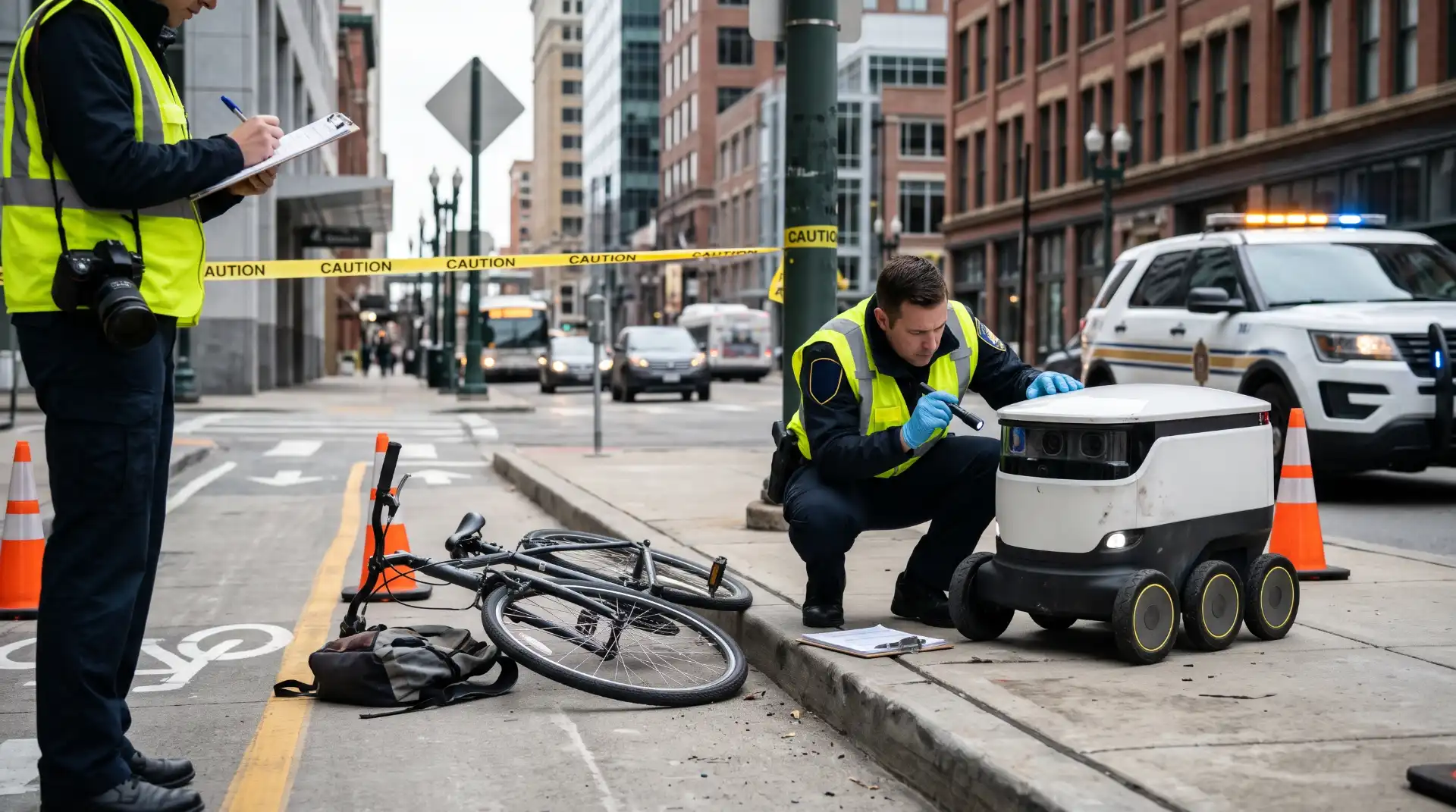
The Role of Autonomous Technology in Accident Investigations
Autonomous delivery robots introduce technical questions that are less common in traditional bicycle accident cases.
A conventional collision investigation may focus on vehicle speed, traffic signals, driver visibility, road conditions, and witness statements.
A robot accident may require investigators to examine how a machine interpreted its surroundings and why it selected a particular movement.
Camera and Sensor Information
Delivery robots may use multiple sensors to identify nearby objects and estimate their position.
This information could help determine whether the robot detected an approaching cyclist before the collision.
For example, investigators may examine whether the machine recognized the bicycle, how much distance separated the two, and whether the robot attempted to stop.
A sensor recording may also help explain whether the machine detected an obstacle but responded incorrectly.
However, sensor information must be interpreted carefully. A system’s detection of an object does not necessarily establish that it correctly identified the object as a cyclist.
GPS and Navigation Records
GPS information may help reconstruct the robot’s route before the collision.
Investigators may compare the recorded route with sidewalk boundaries, bicycle lanes, crosswalks, and areas where robot operation was permitted.
A robot that repeatedly travels through an unauthorized location may raise questions about route planning and company oversight.
However, GPS records can have accuracy limitations, particularly in dense urban areas with tall buildings or other signal obstructions.
They should be considered alongside physical evidence and other records.
Software Updates and Maintenance History
A software update may change how a robot identifies obstacles, responds to pedestrians, or selects routes.
Investigators may need to determine which software version was installed when the accident occurred and whether the company had received warnings about problems with that version.
Maintenance history is equally important.
A dirty camera, damaged sensor, worn brake, or improperly calibrated component may affect the robot’s ability to operate safely.
If the company failed to follow reasonable maintenance procedures, that failure may become relevant to a negligence claim.
Why Independent Technical Experts May Be Necessary
Autonomous delivery systems can be difficult to evaluate without specialized knowledge.
An accident reconstruction expert may analyze the physical evidence and determine how the collision occurred.
An engineer may inspect the robot’s braking system, sensors, and mechanical components.
A software expert may examine navigation records and system logs to identify possible programming errors.
Not every accident requires multiple experts. The decision depends on the seriousness of the injuries, the disputed facts, and the complexity of the technology involved.
Preserving the robot and its digital records before they are altered may be particularly important when a technical defect is suspected.
Can Delivery Robot Companies Be Held Responsible for Sidewalk Obstructions?
A particularly important issue involves delivery robots that block sidewalks, crosswalks, curb ramps, and other public spaces.
Sidewalks are designed primarily to provide safe passage for pedestrians. However, they are also important to people using wheelchairs, mobility devices, and bicycles where cycling is permitted.
When a delivery robot occupies too much space, it may force other road users to change their routes.
Obstructing a Bicycle or Pedestrian Path
Imagine a cyclist approaching a narrow sidewalk that permits shared use. A delivery robot is stopped near a restaurant entrance, leaving insufficient room to pass safely.
The cyclist attempts to move around the machine but loses control and falls into the roadway.
The accident may involve several questions:
-
Was the robot permitted to stop in that location?
-
Did the operator have a reasonable reason to leave the machine there?
-
Could the company have selected a safer stopping location?
-
Was the robot displaying adequate warning information?
-
Did the obstruction create a foreseeable danger?
-
Did the cyclist have a reasonably safe alternative?
The answers could help determine whether the delivery company, property owner, or another party may have legal responsibility.
Blocking Curb Ramps and Accessible Routes
Curb ramps are particularly important because they allow people to move between sidewalks and roadways.
A delivery robot that blocks a curb ramp may force cyclists and pedestrians to enter the street or take a longer and potentially unsafe route.
For someone using a wheelchair, the obstruction could make the normal path completely inaccessible.
If a collision occurs because an individual is forced into an unsafe area, the robot’s position may become an important part of the investigation.
Accessibility requirements may also become relevant, depending on the location, responsible party, and circumstances.
Robots Near Schools and Busy Commercial Areas
Delivery robots operating near schools, shopping centers, and busy pedestrian districts may encounter unpredictable movements throughout the day.
Children may change direction suddenly, pedestrians may walk in groups, and cyclists may approach from multiple directions.
A company deploying autonomous devices in these environments should consider the foreseeable operating conditions.
A route that may be relatively safe on a quiet commercial street could create greater risks near a school entrance or crowded transit stop.
The fact that a robot can technically navigate an area does not necessarily establish that the area is an appropriate place for its operation.
How Cities Can Reduce Delivery Robot Accidents
Local governments have an important role in managing the interaction between autonomous delivery robots, cyclists, pedestrians, and traditional vehicles.
As these machines become more common, transportation planning should consider how they affect existing public infrastructure.
Establishing Clear Operating Zones
Cities may establish rules governing where personal delivery devices can operate, subject to state law and the authority granted to local governments.
Clear operating zones can help reduce conflicts between robots and cyclists.
For example, a municipality may establish restrictions involving crowded sidewalks, school entrances, pedestrian plazas, or particularly narrow pathways where robot operation would create unreasonable hazards.
The precise authority to impose these restrictions varies between states.
Establishing Speed and Stopping Requirements
Speed restrictions are important because a robot traveling too quickly may have difficulty stopping before encountering an unexpected obstacle.
However, maximum speed is only one part of the safety equation.
Companies should also consider braking performance, stopping distance, surface conditions, pedestrian density, and the visibility of approaching cyclists.
A robot traveling at a legally permitted speed may still create a dangerous situation if it suddenly turns or stops without adequate warning.
Requiring Clear Identification and Contact Information
Delivery robots should be identifiable so that members of the public can report dangerous behavior.
Identification markings can help injured cyclists determine which company owns or operates the machine.
Contact information may also help authorities investigate recurring problems.
A clear identification number can be particularly useful when several delivery companies operate similar machines in the same neighborhood.
Creating Effective Complaint and Incident Reporting Systems
Cities and delivery companies can benefit from systems that allow residents to report robots that block sidewalks, enter restricted areas, or behave unpredictably.
Reports should be investigated rather than treated as isolated complaints.
If multiple people report the same problem at a particular intersection, the company may need to examine its navigation software or operating procedures.
Accident and near-miss information can also help transportation planners identify locations where additional safeguards may be necessary.
How Cyclists Can Protect Themselves Around Autonomous Delivery Robots
Although companies operating delivery robots have responsibilities, cyclists can take practical precautions when sharing public spaces with these machines.
Autonomous technology should not be assumed to recognize every possible hazard or respond perfectly to an approaching bicycle.
Maintain a Safe Distance
Cyclists should avoid riding too closely behind delivery robots.
A machine may stop unexpectedly when it encounters an obstacle or receives a remote instruction.
Maintaining additional following distance provides more time to respond if the robot suddenly brakes.
Avoid Passing Without Checking Surrounding Traffic
A delivery robot blocking part of a path may tempt a cyclist to move around it immediately.
However, the safest passing route depends on surrounding traffic, visibility, and local rules.
A rider should check for vehicles, pedestrians, and other cyclists before changing position.
Moving abruptly into a motor vehicle lane can create a more serious danger than the original obstruction.
Pay Attention to Robot Movement
Cyclists should observe the direction in which a robot is traveling.
A machine approaching a crosswalk or intersection may change direction unexpectedly.
If its movement appears unpredictable, slowing down and allowing additional space may reduce the chance of a collision.
Report Dangerous Robot Behavior
Cyclists who repeatedly encounter a robot blocking a bicycle lane or sidewalk can report the issue to the operating company or relevant local authority.
When possible, reports should include the location, time, identification number, and a description of the behavior.
A single report may not establish a safety violation, but repeated complaints can help identify recurring problems.
Use Bicycle Cameras When Appropriate
A properly mounted bicycle camera can record interactions between cyclists, delivery robots, pedestrians, and vehicles.
Video evidence may help clarify how an accident occurred.
However, cyclists should prioritize safe riding rather than attempting to record every encounter.
They should also preserve original recordings and avoid editing potentially relevant evidence.
For additional information about how technology and recorded evidence can help document bicycle accidents, readers can explore Ghost Bikes and Unreported Bicycle Crashes: Why Accurate Crash Data Matters for Cyclist Safety.
How Autonomous Delivery Robot Accidents May Affect the Future of Bicycle Safety
Autonomous delivery technology is likely to remain part of the broader discussion about transportation safety in American cities.
Businesses are interested in reducing delivery costs and finding alternatives to conventional vehicles for short-distance transportation.
At the same time, cities must consider how new technologies interact with existing infrastructure.
More Delivery Robots Could Mean More Shared-Space Conflicts
The introduction of delivery robots does not necessarily create an accident in every situation.
However, increasing the number of machines operating in a limited area may create additional interactions between robots, cyclists, pedestrians, and motor vehicles.
For example, a downtown neighborhood may have narrow sidewalks, crowded intersections, restaurant delivery zones, and several bicycle routes.
If multiple companies operate robots in the same area, the potential for obstruction and unexpected movement may increase.
Transportation planners should consider the cumulative effect of multiple deployments rather than evaluating every robot as an isolated device.
Better Technology Does Not Eliminate Every Risk
Manufacturers are continually developing improvements involving cameras, obstacle detection, navigation, and automated braking.
These developments may help reduce certain collision risks.
However, no automated system should be treated as incapable of making mistakes.
Sensors may have limitations, software may contain defects, and unexpected situations can occur in busy public environments.
Companies must continue evaluating their systems under realistic operating conditions.
Testing should account for cyclists approaching from different directions, pedestrians crossing unexpectedly, temporary construction zones, poor lighting, and changes in sidewalk conditions.
Future Legal Questions May Involve Data and Automated Decision-Making
As autonomous delivery systems become more advanced, accident investigations may increasingly depend on digital evidence.
Questions may arise about who owns sensor recordings, how long navigation information is retained, whether remote operators can access historical data, and how technical records should be preserved after a collision.
Courts may also need to evaluate how existing negligence and product-liability principles apply to increasingly automated commercial devices.
The legal system does not necessarily need an entirely new category of personal injury law for every technological development.
Many existing principles can apply to companies, manufacturers, employees, and other responsible parties.
Nevertheless, the technical details of autonomous systems may create new challenges when proving fault and causation.
The Importance of Clear Insurance and Safety Standards
Insurance requirements can provide an important source of financial protection when a delivery robot causes injuries.
However, minimum insurance requirements may not always be sufficient for serious injury claims.
A collision involving a cyclist can result in substantial medical expenses, long-term disability, and lost earning capacity.
Policymakers and regulators may therefore continue examining whether insurance limits, operating restrictions, and safety requirements adequately address the risks associated with commercial robot deployments.
The objective should be to allow useful technological developments without placing an unreasonable safety burden on pedestrians and cyclists.
Frequently Asked Questions About Autonomous Delivery Robot Bicycle Accidents
Can I sue a delivery company if its robot hits my bicycle?
Yes, potentially. An injured cyclist may have a negligence claim against the company operating the robot if the company’s failure to exercise reasonable care contributed to the accident.
For example, the company may have failed to maintain the machine, ignored known safety problems, or deployed it in an unauthorized or dangerous location.
However, the cyclist must establish the legal requirements for the claim under the applicable state law.
Who pays for medical bills after a delivery robot accident?
The answer depends on the available insurance coverage and who is legally responsible.
A delivery robot operating company may have commercial general liability insurance. A manufacturer may have product-liability coverage, and other businesses involved in the accident may have separate insurance policies.
The injured cyclist may also have access to applicable health insurance or other personal coverage.
Payment is not automatic, and disputes may arise over fault and insurance coverage.
Can the manufacturer be held responsible for a robot’s sensor failure?
Potentially. If a defective sensor or related component makes the robot unreasonably dangerous and contributes to a collision, a product-liability claim may be possible.
The injured cyclist would generally need technical evidence demonstrating the defect and its connection to the accident.
The manufacturer may argue that the failure resulted from improper maintenance, damage, or another cause.
What if a delivery robot blocks a bicycle lane and causes a cyclist to crash?
The company operating the robot may potentially face a claim if its conduct created an unreasonable obstruction and caused the cyclist’s injuries.
The investigation should determine whether the robot was authorized to use that area, why it stopped there, whether the operator could have prevented the obstruction, and whether the cyclist had a reasonably safe opportunity to avoid the collision.
A nearby property owner or another responsible party could also become relevant depending on the circumstances.
Are autonomous delivery robots allowed to operate on sidewalks?
The answer depends on state law and applicable local regulations.
Several states have enacted laws allowing personal delivery devices to operate in pedestrian areas under specified conditions.
Requirements may address speed, dimensions, weight, lighting, braking, identification, insurance, and human monitoring.
Cyclists should not assume that a delivery robot is authorized to operate in every sidewalk, pedestrian area, or bicycle lane.
What if a remote operator was controlling the robot when it hit me?
The remote operator’s conduct may become relevant.
Investigators may examine whether the employee received an alert, had the ability to stop the machine, followed company procedures, and acted reasonably under the circumstances.
The operating company may also face potential responsibility for an employee’s actions under applicable employment and vicarious liability principles.
Can I recover compensation if I was partly responsible for the collision?
Possibly. Many states use comparative negligence rules that allow an injured person to recover compensation even when they contributed to an accident, although the amount may be reduced.
Other states follow different fault-allocation systems.
The specific state law determines how partial responsibility affects recovery.
How long do I have to file a lawsuit?
The deadline depends on the state and the type of legal claim.
Personal injury and product-liability claims may have different limitation periods. Claims involving government entities can also have special notice requirements and shorter deadlines.
Because important evidence may disappear and legal deadlines can be strict, injured cyclists should seek legal advice promptly.
What evidence is most important after an autonomous robot collision?
Important evidence may include photographs of the robot, its identification number, witness information, police reports, medical records, bicycle damage, camera footage, GPS records, and the company’s navigation or sensor logs.
The exact evidence needed depends on how the accident occurred and which party’s responsibility is disputed.
Can a delivery robot company avoid responsibility by claiming that its machine was autonomous?
Not automatically.
Autonomous operation does not eliminate the legal responsibilities that may apply to the company deploying and maintaining the machine.
The operator may still face claims involving negligent deployment, inadequate maintenance, unsafe operating procedures, or other conduct that contributed to an accident.
The legal outcome depends on the facts and applicable law.
Conclusion: Determining Liability When Autonomous Delivery Robots Collide With Cyclists
Autonomous delivery robots are introducing new challenges for American transportation systems. Although these machines may provide convenient alternatives to traditional delivery vehicles, their presence on sidewalks, crosswalks, and other shared spaces can create additional risks for cyclists and pedestrians.
A delivery robot that suddenly stops in a bicycle lane, changes direction without adequate warning, blocks a sidewalk, or fails to recognize an approaching cyclist can contribute to an accident resulting in significant injuries.
Determining who pays for those injuries requires more than identifying the company name displayed on the machine. The investigation may need to examine the operating company, manufacturer, software developer, remote monitoring employees, and other parties whose conduct contributed to the collision.
State laws also play an important role. Requirements involving speed limits, permitted operating locations, human supervision, equipment, identification, and insurance can influence how a delivery robot accident is evaluated.
For injured cyclists, preserving evidence is particularly important. Photographs, witness statements, medical records, robot identification information, video recordings, and digital navigation data may help establish what happened and whether a company or another party acted negligently.
As autonomous delivery technology continues developing, transportation companies and local governments must consider how these machines can safely share public spaces with traditional road users.
Cyclists should not have to accept preventable hazards simply because a delivery device operates without a conventional human driver.
When a collision occurs, injured riders deserve an opportunity to investigate the circumstances, identify potentially responsible parties, and pursue compensation when supported by the evidence and applicable law.
Understanding these emerging legal issues can help protect cyclists’ rights while encouraging safer integration of autonomous delivery technology into American communities.
Disclaimer: This article provides general educational information about bicycle accidents and personal injury law in the United States. It is not legal advice. Laws, insurance requirements, and liability standards vary by state and municipality. Anyone injured in a delivery robot collision should consider consulting a qualified attorney familiar with the applicable jurisdiction.