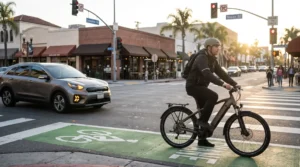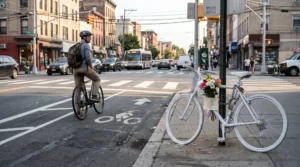
Food delivery services have changed how Americans order meals. Platforms such as DoorDash, Uber Eats, and other delivery apps connect customers with restaurants and couriers who transport orders by car, motorcycle, scooter, or bicycle. In busy cities, bicycle couriers can often move through congested streets more easily than cars, making cycling an appealing option for completing deliveries. However, delivering food by bicycle can also expose riders to serious traffic hazards, especially when they are under pressure to complete orders quickly.
When a food delivery cyclist is struck by a car, collides with a pedestrian, falls because of a road hazard, or causes another person to be injured, an important legal question arises: Can the delivery platform be held responsible for the crash?
The answer depends on the circumstances. A delivery app is not automatically liable simply because a courier was completing an order when an accident occurred. At the same time, a platform’s involvement in the delivery process does not necessarily shield it from every potential claim. The courier’s employment classification, the platform’s level of control, the conduct of other parties, the cause of the crash, applicable insurance policies, and state law may all affect the outcome.
In some cases, the cyclist may be able to seek compensation from a negligent motorist. In others, a pedestrian or driver injured by a courier may have grounds to pursue a claim against the cyclist, a delivery business, or potentially the platform itself. A defective bicycle component, dangerous road condition, or restaurant-related hazard could also introduce additional parties into the dispute.
Understanding these distinctions is important for delivery cyclists, pedestrians, motorists, restaurants, and anyone injured in a crash involving a food delivery order. This guide explains how liability may work in the United States, what evidence can matter, which insurance issues commonly arise, and what injured people can do to protect their rights.
Why Food Delivery Bicycle Crashes Happen
Food delivery cycling differs from ordinary recreational riding. A courier may spend hours riding through crowded commercial districts, navigating unfamiliar neighborhoods, crossing busy intersections, and stopping frequently outside restaurants and apartment buildings. The rider may be carrying a bulky insulated bag, checking delivery instructions, or using a phone to navigate.
These conditions can create hazards even for experienced cyclists. A courier who is trying to reach a restaurant before an order is ready may encounter double-parked vehicles, opening car doors, pedestrians stepping into a bike lane, and drivers making sudden turns. At night, reduced visibility can make these risks worse.
Delivery deadlines and pressure to move quickly
Many delivery platforms use estimated pickup and drop-off times, customer ratings, order notifications, and other performance measures. These features do not automatically prove that an app encourages unsafe riding. However, the way a courier experiences the delivery process may be relevant when investigating a crash.
For example, a cyclist might attempt to cross an intersection before a traffic signal changes because an order is running late. Another courier might glance at a phone to confirm a building entrance while approaching a crosswalk. If that behavior contributes to an accident, investigators may examine the cyclist’s decisions and the surrounding circumstances.
A platform’s role requires a separate analysis. Did the app merely provide navigation and order details, or did its instructions, incentives, or operating practices contribute to a foreseeable safety risk? Were riders given reasonable opportunities to reject orders, pause deliveries, or stop safely to check directions? The answers may be relevant to certain legal theories, but they do not automatically establish that the platform was negligent.
Traffic hazards in urban areas
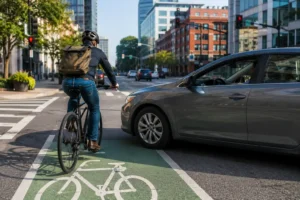
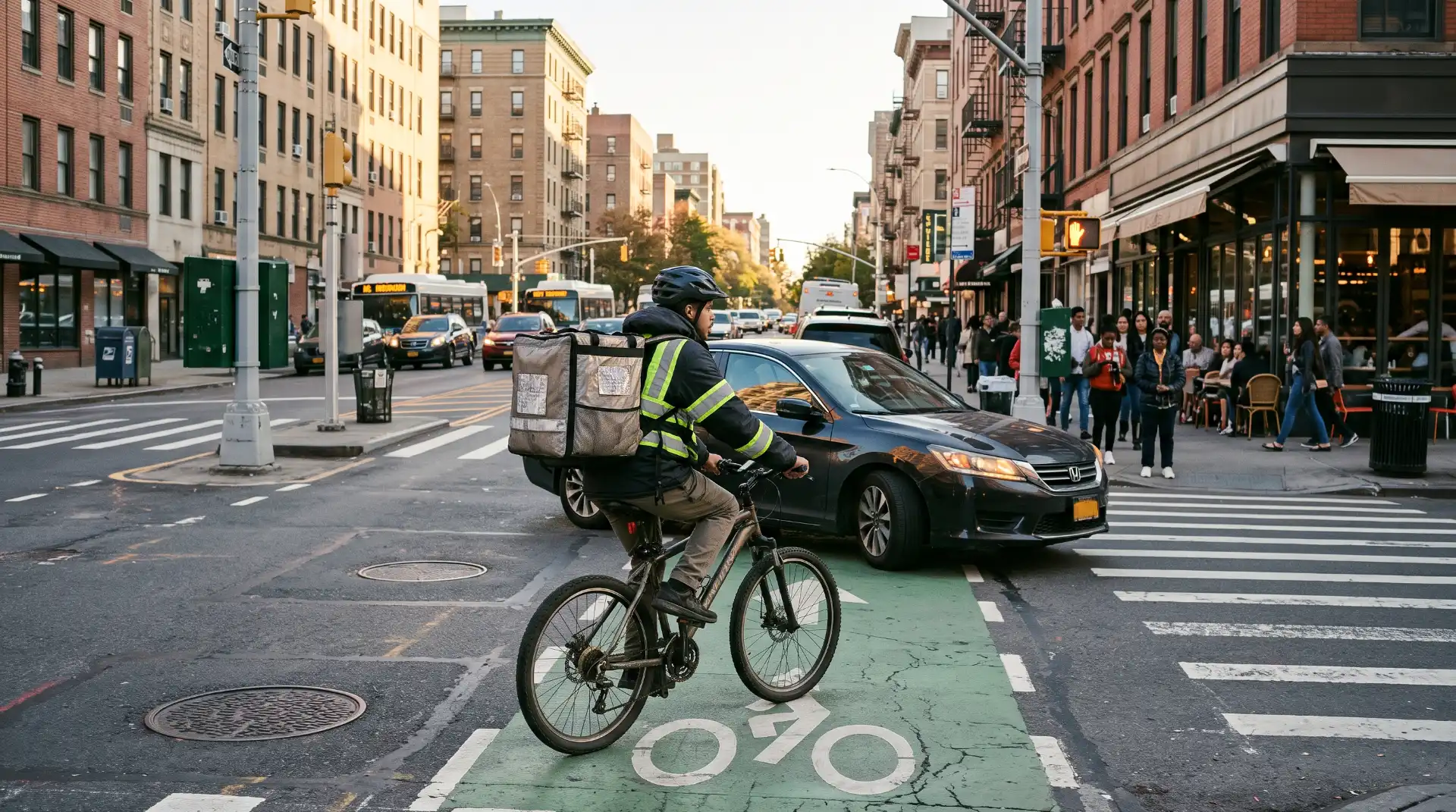
Food delivery cyclists often operate in places where traffic is dense and road space is limited. Vehicles may block bike lanes, drivers may turn across a cyclist’s path, and pedestrians may emerge from between parked cars. Road construction, potholes, poor drainage, and faded lane markings can add further danger.
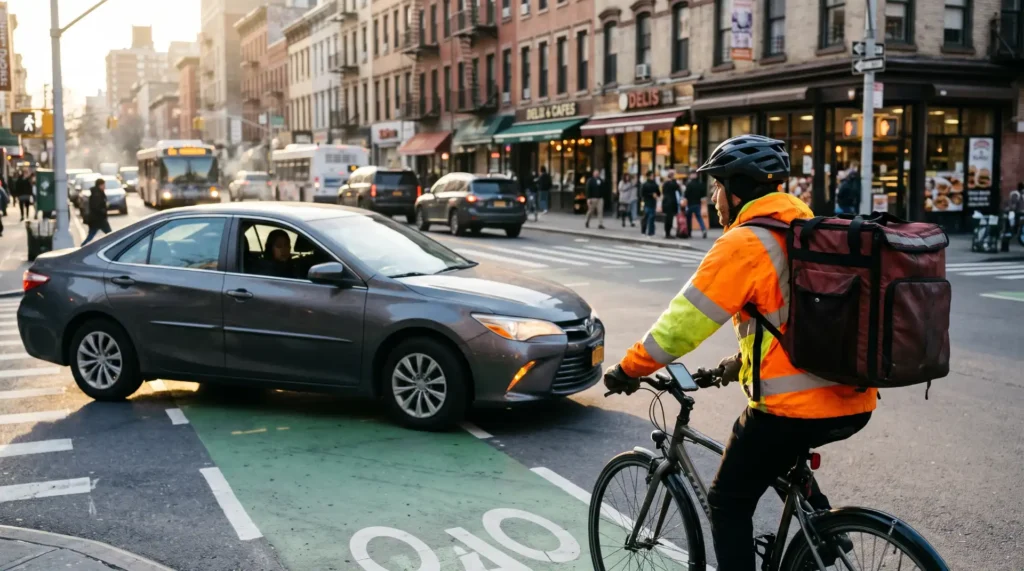
A crash may occur when a driver opens a car door without checking for approaching cyclists. A cyclist may be hit by a motorist who turns right across a bike lane, or a courier may fall after striking a pothole hidden by standing water. These scenarios raise different questions about fault. The driver may have failed to look for a cyclist, a public entity or private property owner may have had responsibility for a particular hazard, or the cyclist’s own actions may be part of the explanation.
Weather can also affect delivery safety. Rain reduces traction, nighttime conditions make cyclists harder to see, and extreme heat can contribute to fatigue. Our guide to seasonal bicycle crash risks involving rain, ice, and extreme heat explains how changing road and weather conditions can increase hazards for people riding bicycles.
Can DoorDash, Uber Eats, or Another Delivery App Be Held Liable?
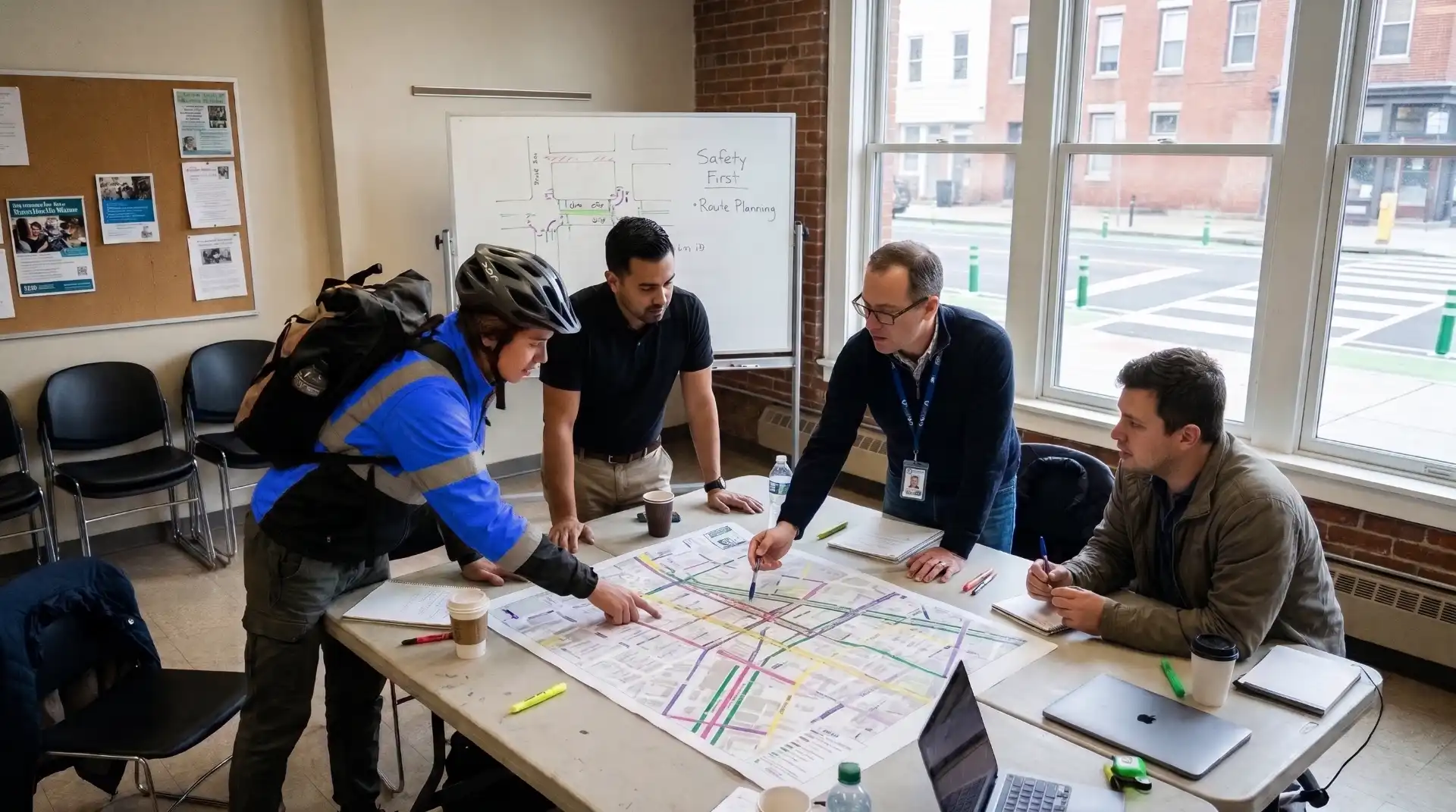
A delivery platform may be named in a claim after a bicycle crash, but being named in a claim is not the same as being legally responsible. Liability generally requires a recognized legal basis, evidence connecting the defendant to the harm, and proof of the elements required under the applicable law.
Depending on the facts, a claim might allege that the platform was directly negligent, that it is legally responsible for a courier’s conduct, or that another duty or insurance arrangement applies. These theories differ, and the law varies by state.
Direct negligence by a delivery platform
Direct negligence means that the platform’s own conduct allegedly contributed to the injury. This is different from claiming that the platform is responsible simply because a courier was using its app.
A possible allegation could involve a platform practice that created a foreseeable and unreasonable safety risk, provided the facts support the existence of a legal duty and a causal connection to the crash. A claimant might examine how delivery instructions were communicated, whether the platform provided particular safety-related information, or whether a specific operating practice played a role in the incident.
However, the existence of delivery targets, customer ratings, or app notifications alone does not prove negligence. A claimant would need to show more than that the platform operates a delivery service and that an accident happened during a delivery. The specific conduct, the platform’s legal duty, foreseeability, causation, and resulting harm would all need to be evaluated.
For example, suppose a platform allegedly directs a courier to a pickup point through an area known to be closed to bicycle traffic, and the available evidence shows that a particular instruction materially contributed to a crash. Whether that creates liability would depend on the precise facts, the platform’s role, and applicable law. A different case involving a courier who independently runs a red light may provide much less support for a direct-negligence claim against the app.
Vicarious liability for a courier’s conduct
Vicarious liability is a legal principle under which one party may be held responsible for another person’s wrongful conduct because of a legally recognized relationship between them. In some cases, an employer can be responsible for an employee’s negligence committed within the scope of employment.
The challenge in delivery-app cases is that many platforms characterize couriers as independent contractors rather than employees. That classification can affect a claim, but it does not automatically resolve every legal question. The relationship may be assessed under the specific law governing the claim, and different legal contexts can apply different tests.
The written contract is relevant, but it may not be the only consideration. The actual working relationship, the degree of control exercised over the courier, the type of claim being pursued, and state law can all matter. The U.S. Department of Labor explains that worker classification under the Fair Labor Standards Act involves an analysis of the working relationship rather than relying solely on the label used by the parties. Its official guidance on employee and independent-contractor classification is useful background, although employment classification for wage-and-hour purposes does not automatically decide liability in a personal injury lawsuit.
Consider a courier who collides with a pedestrian while riding to a restaurant to collect an order. The pedestrian might have a claim against the courier if the cyclist acted negligently. Whether the delivery company can also be held responsible depends on additional questions, including the legal relationship between the parties, the applicable liability rules, and the facts surrounding the collision.
Does being logged into the app matter?
The courier’s app status can be an important piece of evidence. A rider who was waiting for an order, traveling to a restaurant, carrying an order to a customer, or returning home after logging off may be in a different factual position.
Nevertheless, being logged in or completing an order does not automatically make the platform liable. App status may help establish what the courier was doing, but the legal significance of that information depends on the claim and governing law.
For instance, evidence that a rider had accepted a delivery may help confirm that the ride was work-related. It does not, by itself, prove that the platform controlled the rider’s actions or that its conduct caused the accident. A lawyer investigating a claim may need order records, trip details, communications, contractual terms, and other evidence to determine how much the app’s involvement matters.
Who May Be Legally Responsible After a Delivery Bicycle Crash?
The delivery platform is only one possible party in a bicycle accident case. Depending on how the crash happened, liability may involve the courier, a motorist, a restaurant, a vehicle owner, a bicycle or equipment manufacturer, a property owner, or a government entity responsible for road maintenance.
The delivery cyclist
A cyclist can be held responsible for injuries caused by negligent riding. Depending on state and local law, cyclists generally must follow applicable traffic rules, yield when required, use appropriate lighting at night, and operate their bicycles with reasonable care.
Potentially negligent conduct could include riding through a red light, traveling the wrong way on a one-way street, failing to yield to a pedestrian, riding while distracted by a phone, or moving at an unsafe speed for the conditions. A courier’s delivery status does not ordinarily excuse unsafe conduct.
Imagine a courier riding on a sidewalk where cycling is prohibited, approaching a building entrance at speed, and striking a pedestrian. The courier’s conduct could be central to the pedestrian’s claim. Whether the platform shares responsibility would require a separate legal analysis rather than an assumption based solely on the courier’s work status.
The courier may also be an injured person rather than the party at fault. If a driver opens a door into a bike lane without checking for cyclists, the rider may have a claim against the driver even though the rider was delivering food at the time.
A negligent motorist
Motorists frequently feature in bicycle crash claims because turning, passing, parking, and opening vehicle doors can create risks for cyclists. A driver who fails to yield, makes an unsafe turn, drives while distracted, or strikes a cyclist while entering a bike lane may be legally responsible if the conduct caused the collision.
For example, a delivery cyclist may be traveling straight through an intersection when a driver turns across the cyclist’s path. If evidence shows that the driver failed to yield or did not check for approaching bicycle traffic, the driver may be liable for the cyclist’s injuries and other losses.
In such a case, the fact that the rider was working for a delivery app may have little bearing on whether the driver was negligent. The cyclist may pursue a claim against the driver’s auto insurance, subject to the applicable law and coverage. Depending on the circumstances, other claims or insurance sources may also be relevant.
A restaurant or another business
Restaurants can become involved in delivery accident disputes when their own conduct contributes to an injury. For example, a restaurant employee might direct a courier through a hazardous loading area, leave a spill where riders are instructed to collect orders, or negligently create an obstruction near an entrance.
The existence of a restaurant pickup arrangement is not enough on its own to establish liability. The injured person would need to identify the restaurant’s relevant duty and show how a breach of that duty caused the harm.
A restaurant may also be involved in an accident that occurs on its property or in a designated pickup area. Questions about ownership, maintenance responsibilities, warning signs, lighting, and control of the area may become important.
A bicycle, e-bike, or equipment manufacturer
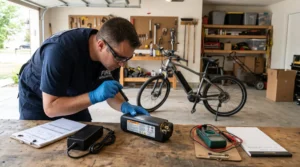
Not every crash is caused by a person’s careless behavior. A defective brake, damaged frame, malfunctioning wheel, or faulty component may contribute to a fall or collision. In appropriate circumstances, a manufacturer, distributor, or seller could face a product-liability claim.
For example, a courier’s front brake might fail during an ordinary stop because of a defect rather than improper use or inadequate maintenance. An investigation could examine the brake assembly, maintenance history, product design, repair records, and whether a warning or manufacturing defect played a role.
A product claim usually requires technical evidence. A failed part does not automatically establish a manufacturing defect, and the cause of the failure may be disputed. Preserving the bicycle and relevant components may be important before repairs or disposal.
A city, county, or other road authority
Some bicycle crashes involve potholes, broken pavement, missing warning signs, unsafe construction zones, or poorly maintained bike lanes. Depending on who controlled the location and what the law requires, a public entity or private property owner may potentially share responsibility.
Claims against government entities can involve special notice requirements, shorter deadlines, immunity rules, and other procedural restrictions. These rules vary by jurisdiction and can make early legal advice particularly important. A road defect alone does not establish government liability; the claimant must assess the applicable duty, notice, causation, and defenses.
How a Courier’s Employment Status Affects Liability
Worker classification is one of the most complicated parts of delivery-platform accident claims. A platform may describe its couriers as independent contractors, but the legal effect of that designation depends on the particular issue being decided.
Employment status can affect whether a company may be held vicariously liable for a courier’s negligence. It can also affect access to certain employment-related benefits, including workers’ compensation in jurisdictions where that system applies. These are related but distinct questions.
Independent-contractor agreements are not the whole story
Delivery platforms commonly use agreements that describe couriers as independent contractors. Such agreements may outline how orders are accepted, how payment is calculated, what conduct is prohibited, and how disputes are handled.
The agreement is relevant evidence, but its label may not control every legal question. Courts and agencies may apply different tests depending on the law involved. The facts of the working relationship can matter, including the degree of control over the work, the worker’s independence, and the legal standard governing the claim.
It is important not to confuse a federal wage-and-hour classification test with the test used to determine vicarious liability in a state personal injury lawsuit. A courier could be classified one way for a particular legal purpose without that classification automatically resolving every other issue.
What evidence might be relevant?
A lawyer investigating the relationship may examine the platform agreement, onboarding documents, delivery instructions, performance rules, app communications, pay records, and the practical ability to decline or stop accepting orders. Evidence about the platform’s role in setting delivery terms or monitoring work may also be relevant to a specific legal theory.
However, not every piece of information will matter equally. A company’s use of GPS, for example, might be intended to show delivery progress rather than to direct every movement of a bicycle. The meaning of that evidence depends on how the system operated and how it relates to the legal test.
For injured cyclists, pedestrians, and motorists, the practical lesson is to avoid assuming that an independent-contractor label automatically ends the inquiry. Equally, it would be inaccurate to assume that every delivery app is an employer for purposes of every accident claim. A careful analysis requires the specific facts and applicable law.
Does Delivery-App Insurance Cover Bicycle Crashes?
Insurance can be just as complicated as liability. The existence of a delivery order does not mean that a platform’s insurance will cover every accident involving a courier.
Coverage depends on the policy language, the people and vehicles insured, the type of claim, the courier’s status at the time, and any applicable exclusions or limitations. A policy that applies to certain motor-vehicle deliveries may not necessarily cover a bicycle courier’s injuries or liability in the same way.
The difference between liability coverage and injury coverage
Liability insurance generally protects an insured party against certain claims by other people alleging injury or property damage. It is different from coverage intended to pay an injured person’s own medical expenses or replace lost income.
A cyclist injured by a negligent driver may be able to pursue the driver’s liability insurer. The cyclist may also have health insurance or other benefits that help cover medical treatment, subject to policy terms and applicable law.
By contrast, if a courier injures a pedestrian, the pedestrian may look to the cyclist’s applicable liability coverage or another potentially responsible party. Whether a delivery platform’s policy responds will depend on its terms and the facts. It should not be assumed that the app’s insurance automatically covers all couriers, all bicycles, or all stages of a delivery.
Personal auto insurance and other policies
When a crash involves a motor vehicle, the driver’s auto insurance may be relevant. If the courier was riding a bicycle and was struck by a car, the driver’s liability coverage may be a possible source of compensation. In some states, the cyclist’s own auto insurance or a household policy could also be relevant, depending on the type of coverage and the circumstances.
Health insurance may pay for treatment according to its terms, but the existence of health coverage does not necessarily determine who is legally responsible for the accident. Depending on the policy and jurisdiction, the insurer may have reimbursement or subrogation rights if the injured person later recovers compensation from another party.
If a courier is injured while working, workers’ compensation may be worth investigating where available. Eligibility can depend on worker classification, state law, and other requirements. A platform’s classification of a rider as an independent contractor does not, by itself, resolve every question about legal status, but a rider should not assume that workers’ compensation automatically applies.
Why policy wording matters
A policy may define when coverage starts and ends, who qualifies as an insured person, what kinds of vehicles are included, and which activities are excluded. Disputes can arise over whether the courier had accepted an order, whether the delivery had been completed, or whether the incident involved a covered risk.
For example, a cyclist might accept an order, collect the food, and then be struck by a car while riding toward the customer. The courier may have a claim against the motorist, while the applicability of any separate delivery-platform coverage remains a different question. The answer requires examining the relevant policies and applicable law.
Injured people should ask for the names of potentially relevant insurers and preserve any written communications about coverage. They should avoid assuming that a platform’s customer-facing insurance descriptions answer every question about a particular bicycle crash.
What if a Delivery Cyclist Injures a Pedestrian or Another Cyclist?
Delivery-related accidents can injure people other than the courier. A pedestrian might be struck on a sidewalk, a cyclist might be hit while passing through a bike lane, or a person stepping out of a parked car might collide with a delivery rider.
In these situations, the injured person may consider a claim against the courier if the cyclist’s negligence caused the injury. Depending on the circumstances, a claim against a delivery platform may also be examined, but it requires an independent legal basis.
A pedestrian hit while crossing a sidewalk
Suppose a courier is checking a delivery address on a phone while riding through a crowded pedestrian area. The courier fails to see a person crossing the path and strikes them, causing a broken wrist. The injured pedestrian may investigate whether the courier failed to use reasonable care.
The platform’s potential responsibility would depend on additional facts. Did the platform’s own conduct contribute to the collision? Does a legally recognized relationship support vicarious liability? What law applies to the claim? Merely proving that the courier had an active delivery would not automatically answer those questions.
A collision between two cyclists
A delivery rider may collide with another cyclist while changing lanes, passing, or entering an intersection. Each rider’s actions may be examined, including speed, visibility, right-of-way rules, and whether either cyclist was distracted.
If both cyclists contributed to the crash, comparative or contributory fault rules may affect the injured person’s recovery. These rules differ across states. Some jurisdictions reduce compensation according to the injured party’s share of fault, while others impose stricter limits on recovery when a person is partly responsible.
A courier collides with a parked or moving vehicle
If a courier hits a parked vehicle, the vehicle owner may seek compensation for property damage. If the cyclist collides with a moving car, each party’s conduct may be examined. The courier’s delivery status does not eliminate the need to determine who caused the collision.
A vehicle owner’s claim against a cyclist also does not automatically become a claim against the delivery platform. The owner would need a legal basis to hold the platform responsible, such as a viable vicarious-liability theory or evidence of the platform’s own negligence.
What Injured People Should Do After a Food Delivery Bicycle Crash
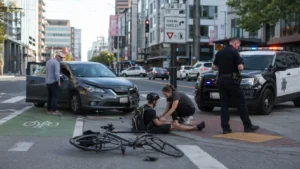
The steps taken after a delivery-related bicycle crash can affect both recovery and the ability to establish what happened. Safety and medical care should come first. Evidence collection and insurance questions can be addressed when it is safe to do so.
Seek medical attention promptly
Anyone who may have been injured should seek appropriate medical care. Bicycle crashes can cause concussions, fractures, soft-tissue injuries, spinal trauma, and internal injuries. Some symptoms may not appear immediately, and adrenaline can make the initial impact seem less serious than it is.
Call emergency services for serious injuries, loss of consciousness, suspected head or spinal trauma, difficulty breathing, severe bleeding, or other urgent symptoms. Even when an injury appears minor, a medical evaluation may help identify problems that are not obvious at the scene.
Medical records can also help document the connection between the crash and the injuries. Keep discharge papers, treatment notes, prescriptions, bills, referrals, and records of follow-up appointments. Our article on common bicycle accident injuries and treatment options provides additional background on injuries that may result from a bicycle collision.
Report the crash when appropriate
If a motor vehicle is involved, someone is seriously injured, or the circumstances require a report under local law, contact law enforcement. Provide accurate information and obtain the report number when one is available.
If the crash occurred on private property or involved a delivery business, document the location and the people involved. Where appropriate, notify the relevant property owner, business, or insurer. An incident report can help establish the time, place, and initial description of the accident, although it may not resolve every dispute about fault.
Do not assume that an app’s customer-support process replaces a police report, an insurance notification, or a legally required notice. These procedures serve different purposes and may have different deadlines.
Preserve evidence from the scene
If it is safe, photograph the crash location, traffic signals, road markings, bicycle damage, vehicle damage, visible injuries, delivery bags, and any hazards that may have contributed to the collision. Record the date, time, weather, lighting, and direction in which each party was traveling.
Collect names and contact details for witnesses. If a driver was involved, obtain the driver’s contact and insurance information as permitted by law. If the courier was using a delivery app, note the platform and any relevant order information without unnecessarily exposing private customer details.
Preserve potentially relevant app notifications, delivery records, GPS information, messages, and photographs. A rider should avoid deleting information that may help establish the sequence of events. A person who was struck by a courier should similarly preserve communications and any available evidence identifying the rider or platform.
Our guide to the importance of gathering evidence after a bike accident explains why photographs, witness accounts, police reports, and medical records can be valuable when liability is disputed.
Identify the parties and possible insurers
Make a list of everyone who may have been involved: the courier, any motorist, witnesses, the restaurant, the delivery platform, and the owner or manager of the location where the crash occurred. Record relevant vehicle or bicycle details and preserve any information that identifies the delivery order.
If an insurer contacts you, provide accurate basic information, but be cautious about giving a recorded statement or accepting a settlement before understanding the full extent of the injuries and available coverage. You may wish to consult a qualified attorney before signing a release or agreeing to a final settlement.
Do not assume that a company is liable because its name appears on a delivery bag or app screen. Identifying the right parties is a starting point for investigating responsibility, not proof that every identified party is legally at fault.
What Evidence Can Help Establish Platform Liability?
Claims against delivery platforms can be difficult because key information may be held by the platform, courier, restaurant, or another party. The evidence needed depends on the theory of liability being considered.
App records and delivery timelines
Relevant records may include the time an order was accepted, pickup and drop-off timestamps, route information, app notifications, and communications between the platform and courier. These records may help reconstruct the courier’s activity immediately before the crash.
However, a GPS record showing a courier’s location does not necessarily prove why the courier was traveling in a particular direction or whether the platform controlled the rider’s conduct. Evidence must be interpreted in context and compared with witness statements, physical evidence, and other records.
Witnesses and video footage
Witness accounts may help explain whether a courier was distracted, whether a motorist failed to yield, or whether a pedestrian entered a crossing. Video footage from nearby businesses, homes, traffic cameras, or vehicle cameras may capture important moments before and during the collision.
Video can be overwritten or deleted, so prompt preservation requests may be valuable. An injured person or their representative can identify nearby cameras and ask the owner to retain relevant footage. Whether the owner is required to provide it, and how it may be obtained, depends on the circumstances and applicable law.
Contracts, policies, and safety practices
If a claim specifically concerns a delivery platform’s conduct, relevant evidence might include the courier agreement, safety-related instructions, delivery rules, and communications about the incident. In some cases, discovery in litigation may be used to request documents that are relevant and legally obtainable.
Not every internal platform record will be admissible or decisive. The central question is whether the evidence supports the elements of the particular legal claim. A large volume of app data may be less useful than a small number of records that clearly establish a key fact about the crash.
Expert analysis
Serious or disputed crashes may require expert assistance. An accident reconstruction expert may analyze the scene, vehicle or bicycle damage, available video, and physical measurements. A medical expert may address the nature of an injury and its likely relationship to the crash. A bicycle mechanic or product expert may examine a suspected component failure.
Experts can help explain technical issues, but their conclusions must be grounded in reliable evidence. The cost and usefulness of expert analysis depend on the severity of the injuries, the disputed issues, and the potential value of the claim.
What Compensation May Be Available After a Delivery Bicycle Crash?
If a person proves that another party is legally responsible, the injured person may be entitled to recover certain damages. The available categories and the rules governing recovery depend on state law, the evidence, and the nature of the claim.
Medical expenses and future treatment
Compensation may include reasonable medical expenses related to the accident, such as emergency care, hospital treatment, surgery, medication, rehabilitation, and follow-up appointments. If the injury requires future treatment, evidence may be needed to establish the likely nature and cost of that care.
Medical records, bills, treatment plans, and qualified medical opinions can help document these losses. The claimant should keep copies of expenses and avoid assuming that an initial emergency-room bill represents the full cost of recovery.
Lost income and reduced earning capacity
An injured courier may lose income while recovering from a crash. Other injured people may also miss work because of medical appointments, physical limitations, or caregiving needs. Depending on the law and facts, a claim may include provable lost wages or income and, in appropriate cases, a reduction in future earning capacity.
Delivery couriers may have variable earnings, which can make income documentation especially important. Order histories, pay statements, tax records, bank deposits, and other reliable records may help establish typical earnings and the financial effect of the injury.
Pain, suffering, and other losses
Where permitted, damages may also include physical pain, emotional distress, loss of enjoyment of normal activities, and other non-economic harm. The availability and valuation of these damages depend on the jurisdiction and the evidence.
A serious bicycle crash may interfere with work, recreation, family responsibilities, and everyday independence. A claimant may find it helpful to keep a simple record of symptoms, treatment, activity limitations, and changes in daily life. Such notes should be accurate and factual rather than exaggerated.
Bicycle damage and other property losses
A claim may include the cost to repair or replace a damaged bicycle, helmet, phone, delivery equipment, or other property, subject to applicable law and proof. Keep receipts, repair estimates, photographs, and purchase records where available.
If the bicycle may have been defective, avoid discarding or substantially altering the relevant components before the potential product issue has been considered. Repairing the bicycle may be necessary, but documenting its condition first can help preserve evidence.
Wrongful death claims
A fatal delivery bicycle crash may give surviving family members grounds to explore a wrongful death claim under applicable state law. Eligible claimants, recoverable damages, and procedural requirements vary. Some cases may also involve a survival action or other claims, depending on the jurisdiction.
These matters can be especially time-sensitive and emotionally difficult. Families may benefit from prompt legal guidance to understand potential defendants, available insurance, evidence-preservation needs, and filing deadlines.
How Shared Fault Can Affect a Claim
A delivery bicycle crash may involve more than one person’s negligence. A driver might turn across a bike lane while a courier is riding too fast for the conditions. A pedestrian might step into a bicycle’s path, or a road defect might contribute to a collision in which both a driver and cyclist made mistakes.
States use different rules to determine the effect of shared fault. Under comparative negligence systems, a claimant’s recovery may be reduced by the percentage of fault assigned to them. Some jurisdictions apply modified comparative negligence rules that bar recovery once a claimant’s share of fault reaches a specified threshold. Other jurisdictions use different approaches, including contributory negligence in limited circumstances.
These rules can affect both injured couriers and people injured by couriers. A delivery rider who is partly responsible for a collision may still be able to recover in some states, but the amount may be reduced. In another jurisdiction, the same allocation of fault could have a more restrictive effect.
The platform’s potential liability must still be evaluated separately. The fact that a courier contributed to a crash does not automatically establish that the platform is responsible for the courier’s conduct. Likewise, a motorist’s negligence does not necessarily eliminate every other possible cause. Evidence and the applicable state law determine how fault is allocated.
Deadlines for Filing a Food Delivery Bicycle Accident Claim
Legal deadlines can determine whether an injured person is able to pursue compensation. Every state has statutes of limitation that set time limits for filing different types of lawsuits. The deadline may depend on the claim, the defendant, the claimant’s age, the type of injury, and other circumstances.
A personal injury claim against a private individual or company may have a different deadline from a claim involving a government entity. Claims against a public agency may require an administrative notice within a much shorter period before a lawsuit can be filed. Missing a required deadline can seriously affect a person’s ability to recover compensation.
The time limit for filing a lawsuit is also different from an insurance company’s reporting deadline. A policy may require prompt notice, and evidence can disappear long before the statutory deadline expires. Relevant app records, video footage, witness recollections, and damaged equipment may be difficult to recover if an investigation is delayed.
For these reasons, anyone injured in a food delivery bicycle crash should avoid assuming that there is plenty of time to act. Promptly documenting the accident, identifying potential parties, and obtaining advice about the deadlines that apply can help protect a claim.
Can a Delivery Platform Be Sued Even if the Courier Is an Independent Contractor?
Potentially, yes—but a lawsuit against a delivery platform still needs a valid legal basis. An independent-contractor agreement may complicate a vicarious-liability claim, but the agreement’s wording is not necessarily the end of every possible inquiry.
An injured person may investigate whether the platform’s own conduct caused or contributed to the crash, whether a different legal relationship applies under the governing law, or whether another party’s conduct is responsible. The evidence might support a claim against the courier alone, a claim against a motorist, or a case involving multiple defendants.
For example, suppose a courier strikes a pedestrian after failing to yield at a crosswalk. The pedestrian may have a negligence claim against the courier. Whether the platform can also be held liable depends on the applicable legal standard and the facts showing the platform’s relationship to the courier and any alleged wrongdoing.
Now consider a different situation: a courier is injured after a driver makes an unsafe turn across a bicycle lane. The courier’s primary claim may be against the motorist, regardless of whether the delivery platform could be liable under some separate theory. The rider’s work status and any available insurance could affect the practical handling of the claim, but the driver’s conduct remains central to the collision analysis.
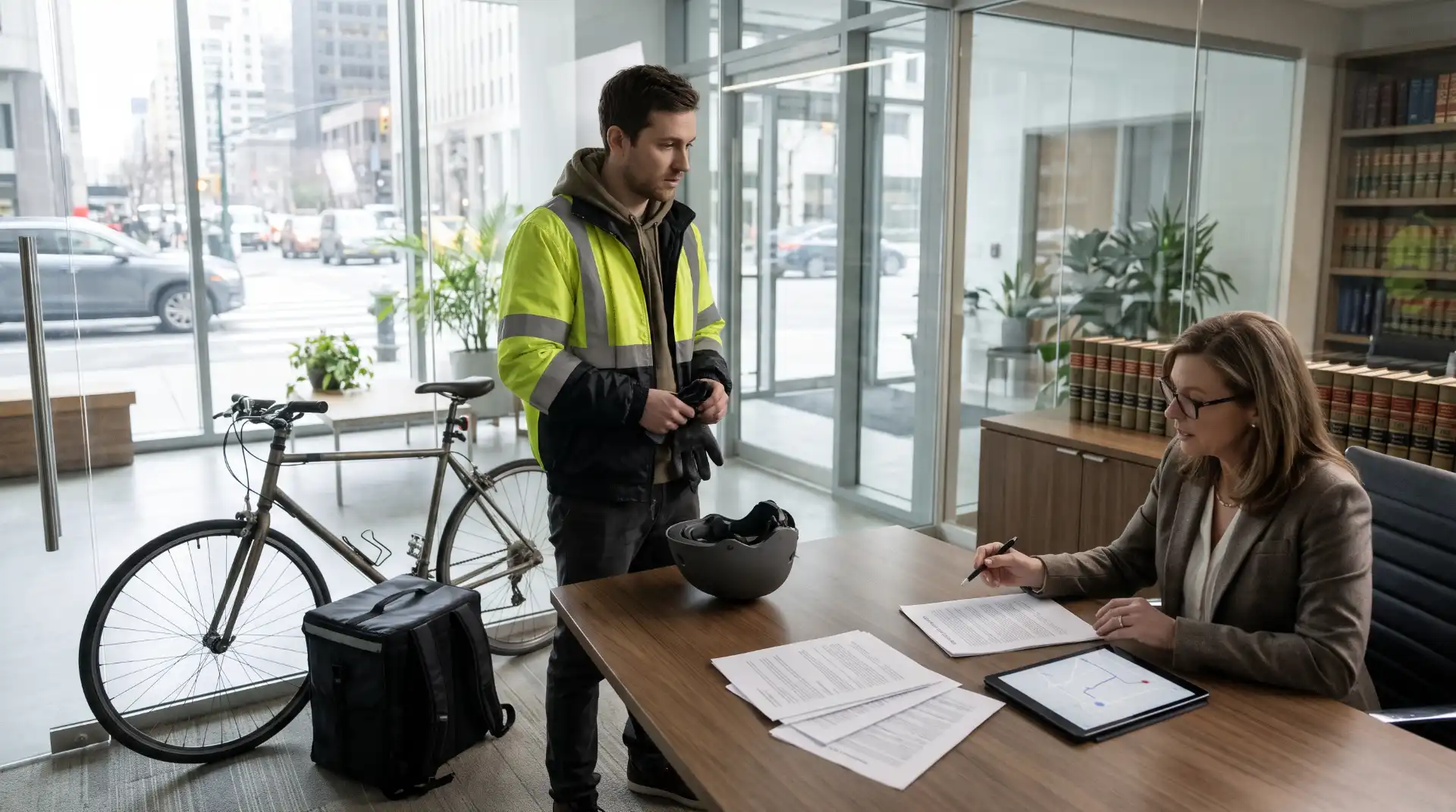
A lawyer can evaluate whether the facts support claims against additional parties and whether pursuing those claims is worthwhile. It is important to distinguish between a party that may have relevant information or insurance and a party that can actually be held legally responsible.
Practical Steps for Delivery Cyclists to Reduce Crash Risks
No safety practice can eliminate every bicycle crash, particularly when a driver or another road user acts negligently. Nevertheless, delivery cyclists can take practical steps to reduce avoidable risks.
Put road safety ahead of delivery speed
Couriers should obey traffic signals, yield when required, use permitted routes, and ride at a speed appropriate for traffic, pedestrians, visibility, and road conditions. A delivery deadline does not justify running a red light or taking a dangerous shortcut. If an order is delayed because of traffic or an unsafe route, arriving late is preferable to taking an unnecessary risk.
Riders should stop in a safe location before checking navigation, reading delivery instructions, or responding to app messages. Looking at a phone while moving can divert attention at exactly the moment a cyclist needs to notice a turning vehicle, pedestrian, or road hazard.
Improve visibility and equipment condition
A properly fitted helmet, front and rear lights, reflectors, and visible clothing can help make a cyclist easier to see. The National Highway Traffic Safety Administration provides practical advice on equipment, defensive riding, and bicycle road safety in its official bicycle safety guidance.
Cyclists should also check their brakes, tires, wheels, chain, lights, and other safety-critical components. A delivery bicycle may accumulate substantial mileage, so regular maintenance is important. If a component appears damaged or unreliable, the rider should address the problem before continuing to make deliveries.
Delivery bags should be secured so they do not shift or interfere with steering. Heavy loads can affect balance and stopping distance, particularly when the cyclist must turn suddenly or travel over uneven pavement.
Plan for weather and traffic
Rain, poor lighting, road construction, and heavy traffic can increase the difficulty of a delivery ride. Riders should adjust speed, increase following distance, and use extra caution around painted road markings, metal covers, puddles, and other potentially slippery surfaces.
Cyclists should be particularly alert near parked vehicles, intersections, driveways, and restaurant pickup zones. Drivers may open doors or pull out without seeing an approaching bicycle. Maintaining a predictable line and allowing enough space where possible can help reduce risk.
Report hazards and safety concerns
If a courier encounters a dangerous road condition or repeated delivery-related safety problem, reporting it may help create a record and alert the appropriate party. Depending on the situation, the report may go to a local road authority, property manager, restaurant, or delivery platform.
A report does not guarantee that a hazard will be corrected or that a later accident claim will succeed. Still, dated and specific reports can sometimes help establish that a problem was known or documented before a crash. Riders should describe the hazard accurately and retain copies of relevant communications.
What Delivery Platforms and Restaurants Can Do to Improve Safety
Delivery platforms and restaurants can help reduce preventable risks by designing practical procedures that account for how couriers actually travel. Safety is not solely the responsibility of the cyclist, particularly in busy urban environments where road design, traffic, and business operations all influence risk.
Platforms can review how delivery estimates and performance systems operate, provide clear guidance about safe riding, and make it easy for couriers to pause or reject an unsafe delivery. Navigation tools should be designed to minimize confusion, and riders should be able to review directions without needing to interact with a phone while moving.
Restaurants can help by creating clearly marked pickup areas, avoiding obstructions near entrances, and providing accurate information about where couriers should collect orders. When pickup areas are crowded or poorly designed, cyclists may be forced to maneuver around pedestrians, cars, and other delivery riders in limited space.
Cities and local agencies also play a role through the design and maintenance of bike lanes, safe intersections, lighting, signs, and road surfaces. Effective prevention often requires coordination between road authorities, businesses, motorists, cyclists, and delivery services.
These measures may reduce risk, but their existence—or absence—does not automatically determine legal liability in a particular crash. A claim still depends on the duties recognized by applicable law, the conduct of the parties, and evidence linking that conduct to the injury.
Frequently Asked Questions About Food Delivery App Bicycle Crashes
Is DoorDash automatically responsible if a delivery cyclist causes an accident?
No. DoorDash is not automatically liable simply because a courier was completing a DoorDash order. Liability depends on the facts, the legal relationship between the company and the courier, the applicable law, and whether a recognized legal theory supports holding the company responsible. The courier may be liable, and other parties may also share responsibility depending on the circumstances.
Can an injured delivery cyclist sue Uber Eats after being hit by a car?
An injured cyclist may have a claim against the negligent driver and may investigate whether any additional parties are legally responsible. Whether Uber Eats can be held liable depends on the specific facts and applicable law. The cyclist should also investigate potentially available insurance and any employment-related benefits that may apply.
Does the platform’s independent-contractor agreement prevent a lawsuit?
Not necessarily. The agreement is relevant, but it may not settle every legal issue. Different laws use different standards to evaluate worker classification and responsibility. An attorney can review the agreement, the actual working relationship, and the particular claim to determine whether a lawsuit against the platform has a viable basis.
What if a delivery cyclist hits a pedestrian?
The injured pedestrian may have a negligence claim against the cyclist if the cyclist’s conduct caused the injury. A claim against the platform may also be examined if the evidence and applicable law support a separate basis for liability. The pedestrian should seek medical attention, preserve evidence, identify witnesses, and document the circumstances of the collision.
Does delivery-app insurance cover every bicycle accident?
No. Coverage depends on the policy language, who is insured, the type of accident, the courier’s activity at the time, and applicable law. Some policies may apply to certain delivery-related risks but not others. Injured people should identify relevant policies and obtain a clear explanation of the coverage rather than assuming that the platform will pay.
Can a courier receive compensation if they were partly at fault?
Possibly. The result depends on the jurisdiction’s fault rules and the circumstances of the crash. In many states, comparative negligence can reduce a person’s compensation according to their share of responsibility. Other states apply different rules that may restrict recovery more significantly. A careful investigation is important when fault is disputed.
How long does a food delivery bicycle accident claim take?
There is no universal timeline. A relatively straightforward claim with clear liability and well-documented injuries may resolve more quickly than a case involving severe injuries, disputed worker status, multiple defendants, or disagreements over insurance coverage. Medical recovery, evidence collection, negotiations, and litigation can all affect the duration.
Should I contact a lawyer after a delivery-related bicycle crash?
Legal advice may be especially helpful when injuries are serious, fault is disputed, a delivery platform may be involved, insurance companies disagree about coverage, or a government entity may be responsible for a road hazard. An attorney familiar with bicycle accident claims and the relevant state law can help identify potential defendants, preserve evidence, and explain filing deadlines. The decision should be based on the circumstances and the person’s needs.
Conclusion: Delivery-App Bicycle Crash Liability Depends on the Facts
Food delivery app bicycle crashes can raise complex questions about negligence, worker classification, insurance, and responsibility. DoorDash, Uber Eats, and other platforms are not automatically liable every time a courier is involved in an accident. However, their potential responsibility should not be dismissed solely because a courier agreement uses the term independent contractor.
The courier’s conduct, the actions of motorists and pedestrians, the platform’s own practices, the condition of the bicycle, road hazards, and the applicable law may all influence the outcome. In some cases, the strongest claim may be against a negligent driver or cyclist. In others, evidence may justify investigating the platform, a business, a product manufacturer, or a road authority.
Anyone involved in a delivery-related bicycle crash should prioritize medical care, document the scene when safe, preserve relevant records, identify witnesses, and avoid making assumptions about insurance coverage or liability. It is also important to act promptly because evidence can disappear and legal deadlines may apply.
Ultimately, whether a delivery platform can be held responsible depends on the specific facts and the legal basis for the claim. A careful investigation and advice from a qualified attorney in the relevant state can help an injured person understand their options and determine the appropriate next steps.
Disclaimer: This article provides general educational information about United States law and is not legal advice. Liability rules, insurance coverage, worker-classification standards, and filing deadlines vary by jurisdiction. Consult a qualified attorney about the facts of a particular case.